Wednesday, 18 December 2019

Midnight Collective Christmas Video 2019


Welcome to the Midnight Collective Broadsheet 169 
Actively supporting NZ’s endangered wetland birds


We are so pleased with our ducklings that we have turned our video over to them this year.   But what a year – Will it ever  turn round for the better?

As we put this down our neighbours in Australia are bracing for their hottest day ever and it's only mid-December. Out of control fires have been raging across the continent for weeks now, with emergency services pleading with the Government to take climate change seriously, but no, their powers-that-be are holding fast to the title of the dopiest deniers on the planet.

Meanwhile, 1200km to the east,  where we are starting to take it seriously, our early summer is pretty much normal so far. Wind, thunderstorms, washouts and lots of rain for our wetlands and our ducklings. So plenty of lush green growth but loads of swimming going on too with the schools now out and the kids running amuck- Though watch out. That Australian smoke and brimstone is heading this way.

So what can you do? 

Well, have a good Christmas for a start, beginning with these fotos from the best little Christmas display in the world! Which is just down the road from here. 
Then come the new year, keep working and expanding your reserves, wetlands and wildlife sanctuaries, right across the planet.

So Mere Kirihimete to you all as our hearts go out to all those caught up in the volcanic tragedy on Whakaari (White Island). 

Track we were listening to while posting this - well it had to be didn't it - Last Christmas- from the Wham boys -
Last Christmas
I gave you my heart
The very next day
You gave it away... (sigh)

Here's hoping it wont be retitled - The Last Christmas- in 2020


Saturday, 7 December 2019

Is our destroyed New Zealand wetland reforming?


Welcome to the Midnight Collective Broadsheet 168 
Actively supporting NZ’s endangered wetland birds


Just a quick note to record in fotos a change to the swampy floodplain left by the expressway construction. Here’s what used to be there… A 5-7 hectare lake 
Raumati Beach Dunelake August 2006
Here’s what replaced it in 2017.
 
That’s what the tailback looked like this morning at 8am –7km and growing.
We were initially encouraged in that first autumn  when a large number of wetland birds including putangitangi-paradise duck,  tētē-grey teal and mallard settled here, but it wasn’t to last. The diggers moved in again and redrained the area. For the last two years there have been no significant wetland birds settling or breeding here, save the ubiquitous pukeko (which predate other wetland species). All our medium to rare birds had gone.
In response we began monitoring the new native plantings.
The area was originally forested wetland, dominated by big trees including kahikatea and totara but the new plantings are primarily native understory species limited to a botanical style of landscaping design with four or five local species, then flax and toitoi. It is a big plus of course, but we are not going to get our coastal forest back.
There is a weeding programme but it is mostly confined to areas visible to the public. Elsewhere the weeds are taking back control -blackberry and lupin -  but also weeds brought in by the construction. The worst of these is the willow, but even wild turnip is now proliferating.
New settled water - how long will it last?
However this is very much a moveable feast and the big change appears to be, that this excavated area  appears to be holding water again. It has been a reasonably wet spring and now into early summer (another 40 mm overnight) and this year we have been away a lot, but the return home brought a very pleasant surprise. We have young duckling families again.
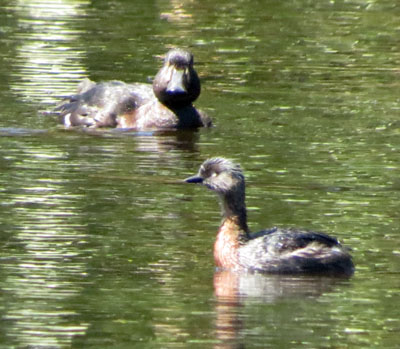
PareraX Mum with ducklings
Australasian Shoveller Mum with ducklings
Two dads (back of picture)
Here’s the Parera cross dad. Mum looks very mallardy, though he was the duck who caught our attention as you can see from this foto,
Parera cross male
He’s a parera, crossed with a mallard, but showing all the behaviour of a parera  by staying with the female. Mallards don’t do this.
The mums are very wary. We were a good 60 metres away but they soon disappeared. 
We are not sure why this water is holding. Even after heavy rain it would  quickly drain so it isn’t the result  of human intervention. A couple of things could be happening - the area may be settling and then  the drains silting up. Long may it continue. 
So Christmas has come early here in Kapiti.  
Track we were listening to while posting this -Because of You-GloriaDe Haven with Guy Lombardo and his Royal Canadians in a draw-dropping performance, as Canadian PM Trudeau might say!!!! from New York City June 1951. 
Because of you
There’s a song in my heart


Monday, 21 October 2019

Royal Albatross mahem at Taiaroa Heads Dunedin NZ


Welcome to the Midnight Collective Broadsheet 167

Actively supporting NZ’s endangered wetland birds
testing the wind
It is spring down south here in Otago. And we are lucky to be here for a three week sojourn, staying at the famous Caselberg Cottage in Broad Bay. It’s 16 km along the peninsula road driving out towards the albatross colony at Taiaroa Head which we visited.  Word is getting around about this place with 160,000 visitors cruising passed here every year now.

This seems hardly surprising when you get out there, because the sheer size and grace of these birds takes you completely by surprise. The colony now has around 21 breeding pairs but their lives are complex. They work two shifts. Last years adults and youngsters left in September to cruise the southern oceans and this years pairs are just arriving. It’s very hit and miss to see them, so we were lucky.
in flight
Boisterous weather is the best time to see them in the air. It’s been a very turbulent and cool spring down here, after a mild winter, but this was a sunny day and calm. There were two sitting out in the colony – a male (grooming in film) then a female, both sitting. Around 11am the breeze picked up  then it was all on. The male wandered (waddled! These big birds don’t so much land as crash into the ground) down to the female. Albatross are famously monogamous, though like us, they can have same sex partners, especially the females. There is a female/female pair here who act as foster mums for at-risk and sick youngsters.

This male started beak tapping with the female who immediately sussed he wasn’t her man and, with great indignation, ran him off her patch. With the wind up new birds began arriving and over the next couple of hours they could be seen circling sometimes alone sometimes in pairs, sometimes in a group of four or five. This all looked like courtship/homecoming behaviour and was delightful to observe.
Scram buster!! (female on left)
These birds weigh up to 8 kilograms (it's rather like picking up a medicine ball), with a wingspan of 9 feet. The winds were knocking the seagulls around but the albatross never missed a beat. Their ability to glide upwind then down, in such blustery winds, was uncanny; even feet from the ground they looked completely safe and at ease. It gave a idea of how those earlier warmblooded Pterosaurs (some with a wing span three to four times longer) must have looked. Then how much windier (perhaps) their climate was than ours.

The youngsters  spend 5 years at sea before coming back to raise youngsters of there own. There’s an interesting history here, because it wasn’t until this headland was cleared, that these birds started to arrive and breed here. They come originally from the Chatham Islands which was becoming rather overcrowded.

Track we were listening to while posting this – Teresa Brewer it had to be! You can hear her again on the film. And again! And again!
Till I waltz again with you 
let no other hold your charms
If my dreams should all come true  
you'll be waiting for my arms
Till I kiss you once again   
keep my love locked in your heart
Darling I'll return and then   
we will never have to part.


Friday, 2 August 2019

Destruction of NZ dune lake Update.


Welcome to the Midnight Collective Broadsheet 

Actively supporting NZ’s endangered wetland birds

We have been getting a bit of stick for not updating this for a while the reason being fingers in a load of other pies – but also the situation has quietened down and we are watching as the wetland and plantings surrounding the destroyed Raumati Beach dune lake settle out. 
            
                        Royal Spoonbill at former dune lake

The minus’s are serious because we no longer see any of these families. 

Mallard Mum and chicks
Parera cross pair

Black swan Mum and chicks

Initially we were pleased because the wild bird life had increased. This was as a result of increased swamp water coverage. However new drainage put an end to it and these new wetlands disappeared along with  the birds. Over the last 12 months there has been very little sign of any birds; with only occasional sightings of mallards. The big beneficiaries have been pukeko (our swamp hen) which is ominous for other nesting species. Pukeko are the main predator of chicks.  
Paradise duck mum and chicks
It is still very early days however in the life of this new swamp. The big plus is the native plantings – these are beginning to establish and while species variety is small and the design more closely aligned to garden design than the original swamp forest that was dominated by kahikatea and totara substantial areas have been replanted in native species. Though we are a long way still, from this - original swamp forest -  
Rata vine at Gordon's Bush swamp forest - Whanganui

                                               Gordon's Bush Swamp forest - Whanganui

We noted previously that willows, that appear to have been brought in by the earth movers, are now a major threat to the wetland. We mentioned this to a party of weed pullers and were dismayed to learn that they had no idea of the seriousness of the infection or that they needed to be removed. However some areas have now been cleared in the north, though the southern infestation looks ominous. The weeds have been pretty aggressive and also brought in from the outside. Last week we were removing turnip seedlings from the NZTA plantings, as one example.


Blackberry is also a huge problem and it is being addressed by mowing. This simply stimulates new growth and spreads it even further. This weeding programme has a limited life with resources  stretched over 23km of expressway, which is another reason why we are waiting to see how all this develops in the longer term.

Early days at the Raumati Beach dune land swamp - flax with totara seedling 

This dune land area provides a very harsh environment for plants, especially in summer where they don’t have the umbrella protection of older trees. Two years ago we had a very hot dry summer and while we lost a number of young trees and flax and toetoe, the damage wasn’t serious. Last year however, over a wetter summer we lost plantings that had survived the previous summer including  supposedly hardy manuka. The weeds however, were not seriously affected.


But its early days yet and here are signs of that the swampland is continuing to settle and deepen. It's beginning to take on a life of its own and here's  a promise of things to come.

Swamp water in plantings - former dune lake. 
What we need are these back living here...
Rest assured… we continue to keep a close eye on the area.

Environmental Artist Jill Studd - francesjillstudd.blogspot.co.nz

Contact Us: vantoohey@gmail.com 


Tuesday, 4 December 2018

The Best Christmas Video of 2018 -Star of the NZ Forest - Puawhananga


Welcome to the Midnight Collective Broadsheet 165
Actively supporting NZ’s endangered wetland birds

puawhānanga
We are at it again and here is our Christmas post – in which we have collaged a flowering puawhānanga into film. 

This is our New Zealand clematis and it takes about a fortnight as the vine buds up in the Spring, coming to full bloom. 
Beginning to bud
The white, so aptly named by Māori – as puawhānanga – the star of the forest (wao) - brings an incandescent plumage to the forest. Locally you can begin to see this again in our forests of the Tararua’s where 1080 has reduced the possum infestations. The vine, ice cream to these Australian pests,  is now making a comeback. 
Inhabiting the Kanuka - Puawhānanga clothes this coastal forest tree
But the best place is Waiheke Island in the Hauraki Gulf. Possum never got out here so the effect on existing forest and regrowth areas on the island makes a wonderfully startling Spring transformation. 

It's been a funny old Spring and early summer this year. 2017 saw drought conditions established November through December and we were in swimming by the end of November. This year has seen steady belts of rain so the landscape is looking deliciously green which is good news for our local regenerating natives.

Track we were listening to while posting this? Well we've gone back to the fifties and early sixties and rat packer Dean Martin... 
When we finally kiss good-night

How I'll hate going out in the storm
But if you really hold me tight
All the way home I'll be warm

He would stumble around on stage in his TV show, then lean on the piano which he would pretend to miss. But was he pretending? Have a few drinks this Xmas, you've earned them, but don't take it as far as the Deano...


Sunday, 11 November 2018

Scaup v Dabchick - Face off at QEII Park wetland - Kapiti NZ


Welcome to the Midnight Collective Broadsheet 163
Actively supporting NZ’s endangered wetland birds
QEII Park wetland 5k south of Raumati Beach
We are well into the breeding season but still little sign of new progeny emerging in our local wetlands.  Down here at the QEII reserve however we caught these two males having a set to.


Dabchick on the left, scaup on the right. These are of course, different species and both males, so here followed a complicated interaction, that gives some insight into inter-species relationships. 

The problem at the centre of it all was the male scaup’s partner who blithely slept through the fracas. They are both diving waterbirds, but the male scaup has a somewhat larger presence and decided the dabchick was getting too close to the female. So he began to eyeball what he took to be a potential rival.

Then kicked up a dickens of a  row when the dabchick didn’t back off.
At which the 'rival' did boat away to a more responsible distance. The female in the meantime had climbed out onto a fallen tree where the male scaup then followed.
Scaup pair - female on the log
But what were the dabchick's intentions? It's difficult trying to figure this out and mostly down to supposition, but we have seen dabchicks hanging out with scaup pairs before and their intention seems to be to socialise. We think the dabchick’s mate is most probably sitting on a nest close by and he was looking for a little company. We watched a female at the Ratanui wetland pal up with a scaup pair. It took a while for them to accept her but then the three would often be seen diving together, until a male dabchick turned up and they all went back to themselves.  Of course a male might not be quite as welcome (to a scaup male) as a female and this male seemed specially bolshy.

Track we were listening to while posting this – well, its 100 years since the closing of the murderous tragedy that was WWI, so we spent some time trying to find the right soundtrack and finally it was Vera Lynn we settled on. Ok it’s the wrong war but nevertheless the right song -We’ll Meet Again- because her original haunting version, manages to imply that it is far more likely that we won’t meet again.
So will you please say hello 
To the folks that I know
Tell them it won't be long
They'll be happy to know 
That as you saw me go
I was singin' this song


Wednesday, 7 November 2018

Pollution closes Wharemauku Stream - Raumati Beach NZ


Welcome to the Midnight Collective Broadsheet 162
Actively supporting NZ’s endangered wetland birds
Bridge over Wharemauku creek at back of airport
The news that a Māori rāhui or prohibition has been placed on the Wharemauku creek is a sobering reminder of how quickly a local waterway can become toxic. It has been placed by local Iwi to prevent the gathering of food (watercress, whitebait, eels etc) after the discovery of campylobacter in the stream.
(note on rāhui - to put in place a temporary ritual prohibition - traditionally a rāhui was placed on an area, resource or stretch of water as a conservation measure or as a means of social and political control.  A rāhui is a device for separating people from tapu things. After an agreed lapse of time, the rāhui is lifted.)
Looking up towards the centre of town
This is the bug that brought Havelock North to its knees in 2016 so it is good news to find our Iwi closely involved in monitoring the health of our water and nipping a possible epidemic in the bud. 
The immediate source of the pollution has yet to be determined but local signage appears to link it to human sewerage spilling from illegally connected pipes. The problem is exacerbated with the opening up of the Wharemauku into the flood plain areas around the expressway, so the pollution will be spreading into a much wider area.
Flood plain area west of expressway
The drain that runs along the back of this area appears also to be affected.  A considerable  stench was coming from this section that eventually drains into the Wharemauku at the back of  the airport.
Drain 7 
Not only humans can be infected. 
White faced heron near Wharemauku
Animals get sick too, and here is film of a white faced heron  seen down here yesterday, feeding in the centre of what may be a polluted area…  

Track we were listening to while posting this? Well, with the US beginning to pull itself together, how could we go wrong with the incomparable Ella’s happiness..
A million years it seems 
Have gone by since we shared our dreams 
But I'll hold you again 
There'll be no blue memories then… 
We've sent this out in red because that's what we are over here!!!