Monday, 27 July 2015

Why this is not a wetland - Privatisation, Serco and the Dune Lake


Welcome to the Midnight Collective Broadsheet 86
Actively supporting NZ’s endangered wetland birds
Dismasted tree  - Raumati dune lake
The privatisation of public assets and responsibilities has hit a major land mine over recent weeks with the revelation that prisoners in Serco-run privatised New Zealand jails have  been left ineffectively supervised and so taken them over.
Rear view 
The issues are politically intriguing because they expose the credo behind the move as foolishly utopian – an ideology that you can have your cake and eat it. These privatised prisons were not only going to be run more cheaply, they were also going to turn out much higher rehabilitation rates.  
This is not a wetland
Nobody queried this, or the uninterrupted stream of media puff issued by the company and the Minister supposedly left in charge, until videos began appearing on the internet, of organised fighting and drug taking.
White faced heron with NZTA crane Raumtai Beach Dune Lake 
The issues raised, run deeply into our free and democratic way of life. Once you pass responsibility into private hands you have ceded control to an organisation whose authority structures are not democratic and whose first commitment lies in protecting itself. During this imbroglio they had to fly the CEO of SERCO into the country to hold a two hour meeting with the minister, before pretending to fire him. 
A sisyphic task - digging out the Raumati Beach dune lake 
Forty years ago there would have been a lot closer relationship between a minister and his CEO as we would expect in running a healthy, open society. A business ethic of secrecy has replaced that ideal and these companies have erected a wall of feel good flutter around themselves. This has proved very effective in an era where the mainstream media, obsessed with ratings, are employing celebrity presenters and peppering their news bulletins with celebrity tripe.   
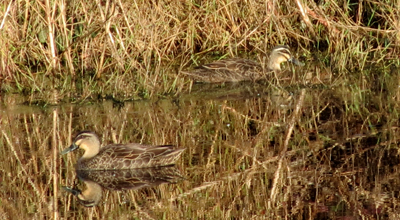
Dune lake with grey teal and parera-cross ducks 
This disquieting fiasco runs right through the initiatives of this Government as it prepares to privatise mental health and child welfare services. It also tells the story of our wetland.
 
Destroyed dune lake July 2015
Scientific evidence, collated by a private firm, was presented to the Board of Inquiry issuing consents for this expressway, that this dune lake was not a wetland. This evidence was accepted by the Board. You can see from the accompanying photographs how wrong they were. This error however isn’t a mistake of observation made by incompetent scientists.  It is part of  a widespread culture of organised misrepresentation.

To be continued…

Track we were listening to while posting this Your Cheatin’ Heart The Keil Isles. What were these Samoan boys (with  Eliza) doing to US  rock n roll in the late 1950’s and early sixties? They brought their own pacific island fizz in mixing rhythm and blues with country and turning it into rockabilly around the same time Johnny Cash was doing the same.
Your cheatin' heart
Will pine some day
And crave the love
You threw away
The time will come
When you'll be blue
Your cheatin' heart will tell on you..  


Friday, 24 July 2015

New Zealand dabchick resicovery - further good news


Welcome to the Midnight Collective Broadsheet 85
Actively supporting NZ’s endangered wetland birds


We were dismayed in February to discover that we had lost our breeding dabchick pair at the Waikanae River estuary. They had been producing youngsters every year but the female suddenly disappeared leaving the male on his own. We then discovered another about 3 kms away on the Ratanui Rd wetland, but it was also a male.

It was great news this morning to find the male once again paired up with a female. It was a chilly morning and difficult light, but here are some images to celebrate the two and hopefully look forward to more chicks later in the year.

This delicate little grebe has been a visitor to the dune lake and is one of our rarest local endemic waterbirds. We knew of three at the end of the breeding season in February then reduced to two. It remains a mystery how they get around. It is assumed they fly at night, though we’ve never seen them take to the air. They may also make their way through many of this areas drains and waterways. So where this little female has come from remains a mystery but her appearance gives us every reason to celebrate…

Track we were listening to while posting this - If you want to be a bird –The Holy Modal Rounders… This track would fly right past anyone born after 1955. It is  fairground music strained through American trades hall stomp, then raised to the level of  cantata brilliance by electrification and concentrated mindlessness  (and the help no doubt of illegal substances). It charts a moment in musical history that will never return…


Tuesday, 21 July 2015

Taking a stand against violence 2 - And now for some good news


Welcome to the Midnight Collective Broadsheet 84
Actively supporting NZ’s endangered wetland birds

In a previous blog  (June 1) we featured a male paradise duck, paired  with a female, left injured by duck shooters.
Injured para - May31 
We didn’t think this bird had much of a chance of surviving but the two appear to have made the Wharemauku their home, with the good news  that he is surviving if not thriving, and the two are still together. Part of the reason for this is that, even though he is limping and dragging a wing, he can still fly. The other factor is the continuing attention he is receiving from his mate.
Paradise duck - putangitangi pair on expressway excavation July 19
Long shot of the pair showing destroyed wetand
Paradise duck females are very maternal. They are constantly on  duty during nesting, very noisy when alarmed and rarely lose a chick. Here this alertness seems to extend to her mate, yet their relationship dynamics are just various as ours. Sometimes the male will be the more assertive, at other times it will be the female.
Disabled male paradise duck 
This seems true of other species as well.

One morning we watched a mallard male make a play for a parera-cross female. Her parera-cross mate was intimidated by the larger more aggressive mallard and continually backed away from a confrontation. The female watched this from afar without comment, but then came an extraordinary moment as the mallard having neutralised his rival, made a play for her. She turned on him her iciest glare. He shrivelled before it at which she simply sauntered passed, back to the mate of her choice. 
Parera-cross pair - Raumati Beach dune lake August 2012
This begins to reveal the complexity of these animals. That the females aren’t simply attracted to the biggest, fittest male; and that they play a decisive role in the choice of their mate.

Perhaps it is because of this female resistance that mallard males have developed gang related behaviours in assaulting females, even as they are protecting ducklings. But then, because there's no accounting for real life, you  get the opposite happening with a female being lured away from her brood by the attentions of a male. There are good mums and bad mums in every species it seems; not to mention deadbeat dad's.

A Note on PAW
Peace Action Wellington is an organisation we follow and support because they campaign against war and violence. They do this by exposing how the tentacles of weaponry production are now reaching into the most surprising areas of our local business activities. They are currently publicising the 2015 Weapons conference – to be held in TSB arena wellington, in November and plan to confront this with uncompromised principles and good humour. You don’t have to live here or get involved to help. Support them by email. Send them some cash. Sign the petition… 

Track we were listening to while posting this Bob Dylan’s  Masters of War. He lost his sense of humour a little on this one…but its hardly surprising.
Come you masters of war
You that build all the guns
You that build the death planes
You that build all the bombs
You that hide behind walls
You that hide behind desks
I just want you to know
I can see through your masks.


Tuesday, 7 July 2015

Destruction of a New Zealand Wetland -update


Welcome to the Midnight Collective Broadsheet 83
Actively supporting NZ’s endangered wetland birds

The NZTA have now successfully destroyed the dune lake because  our birds have abandoned it.
Dune lake July 2015
Dune lake July 2013
The birds we would have seen this year are local mallards which come and go, because most of them hang around the mall complex looking for food from shoppers. Then there were critically endangered parera (NZ Grey Duck) and parera cross birds, along with grey teal-tete  and shoveller. Between 6 and 10 pied stilts have been regular visitors at this time of year, feeding in the shallow lake. Up to 50 introduced Canadian Geese would also use the lake as a night base in winter though they would never settle here during the day because it was too close to humans walking their dogs for their safety.  An occasional rather bewildered looking pukeko still wanders through; then can be found up on the excavations when the trucks aren’t working.
Parera female July 2014
Parera cross pair July 2013
There have been surprising developments following the excavations. The NZTA tried to dig the swamp out when it first began work at the south end of the motorway at Raumati South. They soon gave up, but then tried again, further north at the Raumati Rd overbridge but here seem also to have encountered trouble. They’ve reinforced the side dune against slippage (there’s a house sitting above it), and had to use pumps to continually drain their excavations. No stories about this however, have surfaced in the local media.
Polluted water at the excavation site
Down here at the dune lake they have just scratched the surface of the peat but then piled sand and rock onto it; yet it has been disturbed which has polluted the surrounding area with black swamp water. This is a thousand year old swamp, but despite sitting on 30 feet or more of peat, the dune lake ran clear and clean. This water seeped down through the peat, then when it became waterlogged it drained away beneath the ground, finally being  collected in Drain 7. This runs south to north into and discolouring the Wharemauku, which takes west, down to the sea.
Scooping the top off the peat - Raumati Beach dune lake

This black water however can't get away. It will be harming whatever marine life is left here and  is beginning to smell.         
Pollution monitor out of water July 2015

Detached arm of pollution monitor July 2015
We have also continued monitoring the pollution monitors in the Wharemauku. These were suddenly repaired, but three weeks later they again have fallen into delapidation. We have been working on this issue and when advise of developments as they arise. No-one's talking at the moment however...

Track we were listening to while posting this - well ok he's not known for being an especially pleasant character but on stage well, who cares  so this is for James Brown nevertheless  Get up offa that Thing


Huh! 
Feels good! 
Feels good! 
Do it to me! 
Huh! 
Good God! 
I want you all in the jam!


Thursday, 25 June 2015

Rare volcanic eruption on New Zealand's Tongariro National Park


Welcome to the Midnight Collective Broadsheet 82
Actively supporting NZ’s endangered wetland birds
Te Maari crater Tongariro
Isn’t it odd how seeming misfortune can sometimes turn things round for the better!

Traveling down from Lake Taupo last week we were turned back at the main crossing point through what’s known as the Desert Road because of ice and snow. This rerouted us an extra 50 km around the other side of the mountain complex of Tongariro, Ngauruhoe and Ruapehu. This is the first National Park of NZ and gifted to the country by Tuwharetoa Iwi (Central North Island Maori tribe). It’s a world heritage site and you can see why from these photographs.
Ngauruhoe
Tongariro - steam from Te Maari  on left
Shrouded Ruapehu
It's just as transfixing travelling the long way and an area we know pretty well, through having worked up here on conservation issues. We worked with some of the old mountain guides, who were old enough to remember taking the Prince of Wales up here in a party in the 1920’s. They told of a condition you could fall into if you stayed up on the mountain too long. You’d get ‘Mountain Happy’ and find yourself measuring up visitors to see if they had the right moral qualities to be on the Mountain  and if they came up wanting you’d order them off. At which point you knew it was time to get back to town for a while. Maori perhaps, would understand this more than Pakeha.
To our great pleasure we found Tongariro alive and smoking (actually steaming). This film is of the Te Maari crater which erupted unexpectedly in November 2012. It caught everyone by surprise because it’s usually Ruapehu and Ngarauhoe that are on the go. It is still broiling away, though you can’t get near it of course (for safety reasons)  and we captured the video from a good 15 km’s away.

And then we were also treated to the rare sight of Taranaki sulking in the distance.
 
Taranaki
For anyone wishing to travel this route Ohakune is the ski resort that will get you up onto the Turoa ski field. A must stop here is the world famous ‘Chocolate Éclair Shop’. It’s been churning them out for fifty years and they could export them to New York City herself, and they would be rioting outside the bakery with you New Yorkers trying to get your hands on the very last one (Believe us!)
 
Ohakune Chocolate eclair
Track we were listening to while posting this – it had to be Peter Cape and Taumaranui. This town is about 50 kms away from this area (as the crow flies). It marks the start of the canoe journey down the Whanganui Awa (river). The river Maori hold a pilgrimage down the river ever year. The headwaters are up here on the plateau and much of the water got redirected into lake Taupo in a power scheme that came on track in the early 1970’s. It took 30 years of rigorous campaigning to restore the water levels back up to a level where the Awa could start to breathe again.
 
Typical Awa headwaters bush country 

Friday, 19 June 2015

Stop Press on Kotare (New Zealand Kingfisher) - We have a pair


Welcome to the Midnight Collective Broadsheet 81
Actively supporting NZ’s endangered wetland birds

After all our careful observation, perseverance has finally paid off with the sighting of two kotare on the Wharemauku near the dune lake this morning. They were sitting together and saw us well before we located them, so took off and we couldn’t get a shot of them together but managed to follow their different flight paths to finally get the evidence. 
Female kotare near Wharemauku

Male kotare -near Wharemauku 

So we have a pair and this is the first time in four years that we have seen them together. Though perhaps they are responsible for the youngster at the other end of the creek. If so their nests can’t be close by because they’re usually quite visible as fledglings. They stick close to their mother as they learn how to harvest a meal off the local terrain. 


Thursday, 18 June 2015

Kotare - New Zealand Kingfisher update

Welcome to the Midnight Collective Broadsheet 80
Actively supporting NZ’s endangered wetland birds
Kotare near dune lake over looking Wharemauku
As if to prove us wrong, less than a week after voicing our frustration about spotting kotare at the dune lake, this one came out of hiding in order to pose for us while trying to spot inanga in the wharemauku. This is around two kilometres upstream, from where we filmed our last post and we seem to be right in thinking we are dealing with two different birds. Here are photos of the two so see what you think.
Koatre near dune lake
Kotare at beach end of Wharemauku
We call them both ‘she’ but this is convention because we really don’t know their gender but more colour on their white fronts usually means a male. We think our first bird is the younger of the two. Perhaps she has just fledged which gives us hope that there is a nesting pair around here. (Someplace?).

They are very wary of humans and their dogs and take off almost immediately they spot you, though its noticeable that we are seeing a lot more risk taking from the wild birds at this time of year. Presumably this is because they are a lot hungrier than in summer. 

Kahu - Australasian harrier hawk
If you’re driving out in the country you’ll notice this with kahu (our Australasian hawk). They are not only out in the most atrocious weather this time of year (and this winter is shaping up to be pretty heinous); but swooping dangerously onto the roads while out looking for roadkill. They get so hungry that we have seen one try and pick up a pukeko at the dune lake.

On a lighter note the piwakawaka are back for the winter. This is our delightful little fantail, a pair of whom, were dithering around at the back of the airport. They are impossible to film because like all our little bush birds they have come out of the forest and so never keep still. Sometimes however, you just get lucky…
Piwakawaka at back of aairport 
Fanning!
Track we were listening to while posting this – we are plugging Hello Sailor and Blue Lady this week. Alive and still smokin’ despite losing Dave McArtney a couple of years ago. They go live at the Pumphouse in Auckland and a public bar full  of Kiwi musical legends with them. September 18 – so better get your tickets today…

Found myself a blue lady
To help me through the night
Me and my blue lady 
will make this chance alright (alright)
Jill Studd's Blog
Contact Us