Sunday, 8 April 2018

NZ Wetland to Weedland - How noxious willow weed took over our destroyed dunelake


Welcome to the Midnight Collective Broadsheet 156
Actively supporting NZ’s endangered wetland birds
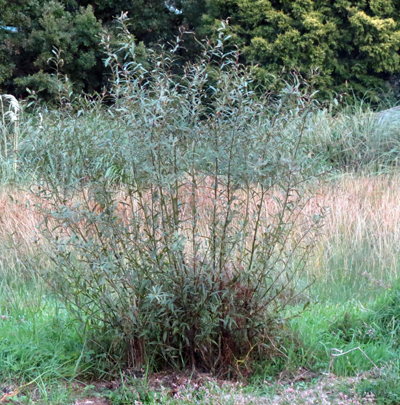
Up and away - willow in the wetland
Over the past few months willow saplings have gone forth and multiplied down on the western side of the M2PP  expressway near the Wharemauku stream. This is a noxious weed that was previously unknown in the area so how did it get in here and can it be contained? 

Don't believe that its noxious? - This is taken from the DoC website
Willow – the scourge of wetlands 
More than 90% of New Zealand wetlands have been 
drained. Crack and grey willow are a scourge in most 
of those that remain, shading out native plant species, 
choking water bodies and even ‘pumping’ wetlands 
dry through their leaves. This leads to a loss of plant 
diversity, a lack of open waterways and the drying of 
wetlands that affects the birds, fish and insects that rely 
on them.

An abundance of seedlings 
There are four likely sources. The first is wind blown and an occasional poplar seedling coming through can be traced to a poplar stand bordering the swamp. There are however no similar stands of willow close to this area, so we can rule that out.

The second source is flooding. The area has been opened up and drained, but is regularly inundated now from both sides. 
Flooding in willow infested area...poplar stand in background

This is the traditional source of willow weeds. However both sides of the expressway get flooded but only the western swamp is infested. There are a few seedlings on the town side, but some of these are above the flood line. 
Willow growing out of planting above flood line
Flooding will be a source, but it can’t account for the level of infestation we are seeing, especially in the south western zone.

This leaves two prime suspects.

New weeds have been appearing here since the work on the M2PP was completed a year ago and some of these are garden botanical specimens like this sweet pea.
Pretty in pink - a sweet pea amongst the willows
These garden plants and the occasional willow, can be spotted growing up through some of the native plantings potted soil, so the nursery stock is one source of contamination.
Spot the willows
The primary source however must be in contaminated topsoil trucked into the area by NZTA contractors. This fits with the spread of the seedlings which are clumped together in blocks along the cycle way and then along the south eastern end. 
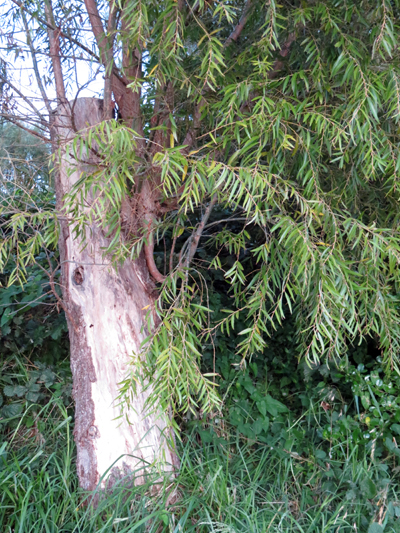
Willow felled and ringbarked at back of  airport - now regenerating
This infestation is very pernicious and will turn what should be a regenerating native swamp area, into a drained willow forest, if it isn’t stopped now.  But how likely is that? 

There are gangs around trying to keep on top of the runaway weed proliferation but when I approached one, they were working to clear areas around the native seedlings to give them breathing space. The theory is that the native plantings will grow in size to smoother the weeds, so they weren’t pulling weeds. They were  working right next to a growing sea of willow seedlings, but were completely unaware of the issue. 

So who will clean this up? 

Well, the NZTA is still in charge but are way too busy putting up signage to show what a great job they have done to take an interest. Besides there are only a couple of years left in the weeding contract, at which point it will presumably devolve back under District and Regional Council jurisdiction. But their scientists don’t get out in the field much anymore. It’s too far away from head office, the lab, and the coffee machine so they keep an eye on things via google maps and Wikipedia. Meanwhile the land itself appears to have been contracted out to a contractor charged with contracting out the contract to a contractor. And his name? Mr Nobody. 

Track we were listening to while posting this? We are back to John Lennon and his plaintive Bob Dylan influenced Nowhere Man
He's as blind as he can be
Just sees what he wants to see
Nowhere man, can you see me at all
Nowhere man don't worry
Take your time, don't hurry
Leave it all till somebody else

Thursday, 22 March 2018

World Water Day- Earth Hour and Kaiapoi crested grebe's


 Welcome to the Midnight Collective Broadsheet 155
Actively supporting NZ’s endangered wetland birds


Here’s a quick advert in support of World Water Day 


Then a Crested Grebe update. We were lucky enough to receive a new foto from Kaiapoi (near Christchurch NZ) of this thriving youngster in pursuit of a parent. 
Australasian Crested Grebe and youngster Kaiapoi wetland (W Schulz) 
They are attracting quite a lot of local attention and thanks to Warwick Schulz for sending in this. These birds are a subspecies of a bird that has spread around the world but is very rare on these islands. 

Some estimates put the population as low as 2-300 and they usually live in hard to access high-country lake districts in the South Island.
Oh and finally, a reminder that its Earth Hour tomorrow (24th March) so a message to Kiwis to get those lights off between 8.30 and 9.30pm. It starts in this country and spreads around the world.

Track we were listening to while posting this…Well its been Van Morrison time all this week with his dizzy, jazz fuelled, intoxicant of a sleeper on rotate. Astral Weeks! Of course it is, though he wasn’t anywhere near as enamoured as we were with this astonishing musical masterpiece that came at us out of nowhere, back in the day.  
If I ventured in the slipstream
Between the viaducts of your dream
Where immobile steel rims crack
And the ditch in the back roads stop
Could you find me?
Would you kiss-a my eyes?
To lay me down
In silence easy
To be born again
To be born again

Tuesday, 20 February 2018

Serious Weather - Cyclone Gita hits the Kapiti Coast New Zealand


Welcome to the Midnight Collective Broadsheet 154
Actively supporting NZ’s endangered wetland birds

This is our third tropical storm in a row, something we’ve been expecting with this endless summer now into a fifth month. Gita caused widespread damage to  Tonga, then circled down through the Tasman Sea to line up the centre of the country.
The calm before the storm - Monday evening mallards  
Fortunately we were only sideswiped here at Raumati Beach with Gita  dropping a little lower south than expected while beginning to break up. 
Running for it. Wetland pukeko with youngster
This still provided an unusual weather pattern from Monday night which we monitored carefully  as the first rains began. It was drizzly overnight but then set in early Tuesday morning so that around 8am we were getting 10mm an hour and expecting severe flooding with the local council advertising sandbags for flood areas.
Not so lucky further south - Slips on the Takaka hill in Nelson - South Island
But then it eased around 10.30am after dropping 30mm and while the Wharemauku rose, it didn’t get much over half full. For 24 hours though, to 6.30 last night there was an eerie dead calm. But then the winds really picked up and there was further rain through the night  which took our total up to 50mm. We were ok here however, though it blew our garden gate down into the drive; but then little damage as we walked around the district this morning. A lot of autumn fruit had fallen early (Thankyou for the bag of pears scattered from a tree in a local lane!!).
Seas close the highway south of Paekakariri
The most spectacular event has been the closure of the Expressway after a slip closed the main road further into Wellington. It was like a scene out of The Walking Dead. 
Deserted M2PP expressway - 8am Wednesday morning
But ah what bliss! No vehicle stream as we walked the wetland this morning around 8 when it should have been at its noisy peak.  

More serious questions are raised by all this regarding climate change. This is certainly the hottest, longest and lately, most turbulent summer we have experienced, and it’s not over yet. Fruit is ripening very early. Pears are a month ahead while we were out picking blackberries in early January. They usually come on in early February. And then there are the fungi. 
The media have been running stories on rural areas picking wild mushrooms and these don’t usually appear until late March or April. We too, have been noticing these large fungi blossoming around our wetland areas, presumably as a result of these warm humid weeks. 
We will be watching our coming winter closely to see if theres a flow on from it all.

Track we were listening to while posting this. We are back to Dylan as he set out his guide to the aging, gloomy pessimism that steered the  soundtrack to Wonder Boys    Things Have Changed
People are crazy and times are strange
I’m locked in tight, I’m out of range
I used to care, but things have changed

Friday, 2 February 2018

Storm surge drama at Kapiti NZ


Welcome to the Midnight Collective Broadsheet 153
Actively supporting NZ’s endangered wetland birds

Over the last three days the remnants of cyclone -Fehi- have travelled down the western coast of these islands then crossed from the Tasman to the Pacific coast.  So it has  been a turbulent few days with the muggy, low pressure system traversing the South Island, egged on by a rare blue blood moon. 
The cause of it all?   Blue Blood moon setting - foto Frances Jill Studd
There has been flooding, tourist strandings, slippages and tree plantation flattenings. Scientists have linked the increasingly wild weather to climate change with flooding on the west coast and major coastal tidal surges.

We are prone to surges here at Raumati Beach with the sanddunes under threat though more spectacularly, they can funnel tidal waves  up into the Wharemauku Stream. The area to about a kilometre upstream, has been rerouted to help control flooding. This steers encroaching waves  underground and though there wasn’t major flooding this time, there has been in the past, with the shopping centre going under water. Our rainfall, which had been threatening  all day  shows why this is of concern. Though the centre of the storm skirted past us dropping a respectable 32 mm on our parched landscape, 20 of that fell in about 30 minutes around six, on the night before these photos were taken.

That wasn't enough to   flood low level housing, but it was scary  all the same with the Wharemauku climbing to about 2/3rds full in  in 20 minutes. But it was the sea breaching inland that caught our attention and here is a photo essay, taken at the next high tide, around 11.30 the following morning with the wind still raucous but the worst now over. 
Sea bulking up at the Wharemauku mouth - this is usually pancake flat and safe for children.

Here it comes - wave funneling through drains kilometre upstream 
And comes
and comes...


This is earthquake country and gives an idea of how a tsunami would behave, careening up this inlet. Though a minor disturbance in comparison, it clearly showed how it isn't the initial wave that is the problem, but the weight of water carried behind it. Further upstream it was still swirling, pushing the still flooding stream back  - the tide reaching further inland than we have previously observed.
Wave continuing its push upstream
around 1.5 kilometres upstream and still going strong
Curiously  we spotted  as much birdlife here, as we have for some time so it must have been stirring up the marine life - and this we observed when for the first time we spotted  a small eel slooping around the excavated channels in the former dunelake area 3 kms away. 
Little Shag surfacing on way upstream
And again - all aswirl in the Wharemauku
Rather lost looking adolescent black swan boating through the waves
Even further upstream a couple of very nervy new generation ducks -
Too early yet to see how much parera genes they are carrying
Track we were listening to while posting this? We are back with The Beatles and a desolately, melancholic John Lennon who is hiding his love away.
Gather round
All you clowns
let me hear you say
Hey!!
You’ve got to hide your love away. 

Update on rare crested grebe discovered at Kaiapoi


Welcome to the Midnight Collective Broadsheet 152
Actively supporting NZ’s endangered wetland birds
This story just got a lot more intriguing. 

We have been lucky to get actual photos of one parent (Crested Grebe), sitting on the floating nest over on the far side of the Kaiapoi lake (away from main road) and the mate out feeding. Difficult to know which is which from this distance as they share the nesting and the feeding.
Foto  Warwick Schulz

Foto Warwick Schulz
These shots were taken a week ago but since then the eggs have hatched and the youngsters can now be seen atop their parent’s backs out on the lake (no photos yet but we are keeping our fingers crossed for more).

The intrigue lies in the display seen during our early morning watch. We assumed this was a prelude to mating and the laying of the eggs, but these two are now outed as having been already a couple of  weeks into brooding on the nest. If they were human beings, we would characterise this as a playful early morning display of affection between committed partners, adept at sharing the load; and not an exhibition of behaviour, as our scientific jargon so presumptuously proclaims, solely aimed at ‘reinforcing a bond that will ensure the male's genes will survive him, while reassuring the female that he’ll hang around for the duration’.

So let's make our view very clear. These are emotionally complex and morally competent animals every bit as much as we strive to be; though in their very different way.

Now, how to put an end to all that spurious  tripe…?

Track we were listening to while posting this? Well it was Paul McCartney who knew the answer to this at 19, and  put it down in  Can’t Buy Me Love,  although Lennon must have helped put some backbone into these lyrics. This was the Beatles first big song out here in Aotearoa, in the days when we were pretty much cosseted away from the world as it was…
Say you don’t need no diamond ring
And I’ll be satisfied
Tell me you want those kind of things
That money just cant buy.

Tuesday, 23 January 2018

Rare Crested Grebes nesting in Kaiapoi New Zealand


Welcome to the Midnight Collective Broadsheet 151
Actively supporting NZ’s endangered wetland birds

Well, before we get to the nesting grebes lets consider the nesting New Zealanders of the moment. 
The happy couple
For those who haven’t yet caught up with it, our 37 year old PM Jacinda Ardern has gone and got herself pregnant. Three months into her reign and already three months gone. Is it a boy? Is it a Girl? well no-one yet knows  though comment of the moment goes to Partner Clarke who said -First we buy the house, then we have the baby, then we get… at which point he was deftly stopped by his canny wife to be, before their wedding plans were let slip.  
Best moment so far?  Jacinda being congratulated at Ratana Pa -
where the  name Waru was proposed for her youngster.
The whole country (well most of it), was and is, agog at the news and what is most charming about all this was all those youngish  Dads who were proffering their opinions in print about what the three of them are in for now.

But now here’s our quick note about a crested grebe pair spotted in Kaiapoi near Christchurch during a recent stay. It’s been a queer summer again when, after weeks of no rain, we now have the turbulent blustery opposite. Christchurch set new records for an extended rainless period, then in January the rain began and when everything should be parched, it has turned the Canterbury  Plains green. 
Kaiapoi Wetland
We visited this wetland close to where we were staying, soon after dawn in steady soaking drizzle so couldn’t get publishable images, but for an hour watched a captivating courtship display by an Australasian Crested Grebe pair. 
These birds are extinct in the North Island and rare now in the South Island and listed as vulnerable. 

We had never sighted them  before so it took a while to twig to what was going on, especially as they were over on the far side of the lake. At that distance, through that gloom, they look a little like oddball geese, yet behave like dabchicks although three times the size. This is the giveaway. They have the same endearing facility to fluff themselves up off the water, then if you watch closely you’ll catch the sight of their legs flailing up out of the water behind. They can’t walk on land and while their webbed feet look something like scaup (who do come out on the bank), they are very light loose, black skin covered appendages that come into their own in jetting them around underwater.

And this was the other giveaway as they disappeared beneath the surface. Yet this pair, rather late in the season as it now is, appeared to be enamoured of each other. The male was especially  attentive in following  the female about. She is a little smaller, and maintained what came across as an annoyed here-we-go-again stoicism. Though she didn’t make a run for it or fight him off until suddenly they engaged in a chipping beak to beak display which looked for all the world like a serious spat, but was the opposite, putting the seal on things, as he went off feeding,  yet coming back to her every time he surfaced.


That appeared to be the limit to their conjugal behaviour, because there didn’t seem to be a nest but a couple of days ago we got the news that they had indeed set up a nest and were incubating three eggs.  
Crested Grebe on nest - Te Ara 
Which is wonderful news to see these usually isolated birds nesting so close to a town.
And finally, well, we’re taking the bull by the horns in putting up as our track for today Lloyd Price I’m Getting Married.

How come my heart deserts me
Burning full of love and desire
How come every time she kisses me
It sets my soul on fire
How come every time she leaves me
It seems like I've lost a part
I may be too young to marry
But not to hide an aching heart

Environmental Artist Jill Studd's blog
Contact Us

Thursday, 21 December 2017

The best Christmas video of the Year


Welcome to the Midnight Collective Broadsheet 150
Actively supporting NZ’s endangered wetland birds

Here’s a fantasy run of video and fotos of park animals taken in Botswana and Namibia earlier in the year that we’ve been saving up for Xmas.

A big thankyou to Bill and Jen Studd They need no further explanation…


Merry Xmas to our growing body of fans and we’ll get back to wetland business in the new year…