Friday, 25 November 2016

New flood inundates Bridge site at M2PP expressway Raumati Beach


Welcome to the Midnight Collective Broadsheet 126
Actively supporting NZ’s endangered wetland birds
At the height of this flood the Wharemauku creek (centre of foto) merged with these flooded areas
Gentrification well underway as this western side begins to flood 
We are putting up a foto essay of a new large flood that swamped the new around the M2PP Wharemauku Bridge site on November 15. This flood reached the same level as the September 4 flood and confirms that this area will now be subject to major flooding events although, once again, this was not a serious flooding event and would not have caused local evacuations in residential areas. 

 
Around 85mm of rain was recorded in Raumati Beach, though upwards of 140mm was reported from the local Tararua ranges. This caused the Waikanae River 10 km to the north, to flood into surrounding farmland. 

One feature of both this and the previous flooding in early September has been the way in which the Wharemauku creek level maintained itself at bank-topping height over a 24 hour period and was still at around 60% capacity the next morning. We have had a very wet spring with two major flooding events. Over the past five years we might have seen one storm like this every two years. We have had two in the last three months. 

No conclusions can be drawn of course, about the long term climate implications, although over time this level of flooding will build up silt in these flooded areas. While this creek can rise very quickly, it usually goes down just as fast. It peaks about an hour after the rain stops but in both these floods this didn’t happen.

Wharemauku Creek monitor 8.14am

Wharemauku monitor 5.10pm at full flood. The  flood of May last year that caused evacuations downstream peaked a foot above this monitor.


Flood water sucked out through drain into the Wharemauku excavations.


Drain backfilling from Wharemauku, early morning.


Flooding begins to inundate new plantings –east of expressway 8.15am


Same eastern area inundated 5.10pm


Western area backfilling 7.45am Gentrification around this area is well underway.


Flood peak in Western area at 5.15pm
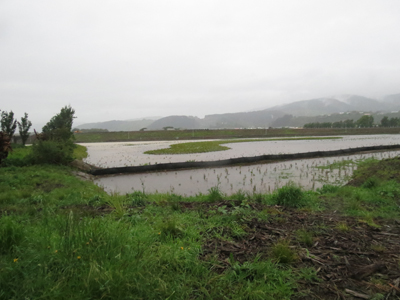

Western area from the back looking north– bridge in distance; centre left 8.15am


The Wharemauku walking track at peak flood downstream in late afternoon sunlight. 5.15pm The major flood of last year peaked three feet above this.

Though it is still very early days in the life of this new area our next post will look at some of the changes that are occurring to the animal and plant life of this area.

Track we were listening to while posting this – Leader of the Pack from the Shangri-Las.


Mm--
"Is he really going out with him?
"Well, there he is, Let's ask him"
"Sam, is that the Trumpets ring you're wearing?"
"Mm-hm"
"Gee, it must be great riding him"


We are thinking of you all in the US of A; pondering as many of you no doubt are, the gerrymander of how someone who loses an election, actually wins. (It used to happen here before we brought in proportional representation). But then hoping you won't take it personally when it comes to the point of breaking off diplomatic relations. (Are they really trying to force the Brits to sack their ambassador? Will the Brits oblige?)


Sunday, 13 November 2016

The Earthquake in New Zealand - An Eyewitness account


Welcome to the Midnight Collective Broadsheet 125
Actively supporting NZ’s endangered wetland birds
Kaikoura - radionz.co.nz

We imagine our followers, especially those living overseas with little experience of such things, will be interested in the earthquake overnight which struck around midnight and was surprisingly severe here at Raumati Beach - surprising, because we live around 200 kilometres from the epicentre.

The big one came through when we were in bed, though not asleep. The first sign was an odd vibration, which generated a moment of dither, because it wasn’t clear what was going on. But then it became very clear, as a rolling motion set in. It felt as if the sea was lifting, then pitching the house around, though at first it was gentle so we just waited for it to settle. We are familiar with earthquakes like this on sand dune country where the force seems to concentrate in certain areas, with others, even a mile away, relatively unaffected. Most just fizzle away to nothing but when this one didn’t and began to gather force it started to get scary.

15 seconds in, it suddenly up the ante. 

The light in the centre of the room began to gyrate wildly, and when the bedroom door started flapping around on a 30 degree arc, we bolted for it. This was about thirty seconds in. We stopped under the door frame (like you’re supposed to), but there was quite a noise now and it just kept getting worse, so we made a run for it down the hall, and out through the front door..


House destroyed north of Kaikoura -radionz.co.nz

We were greeted by an eerie sight. The power had gone, so the neighbourhood was in darkness, but with a full moon, the garden and drive were still clearly lit. Shrubs and small trees were swaying violently from one side to the other, though overhead a most extraordinary lightning show was taking place. This was so unexpected and strange, that we thought it must be from broken power lines, but a friend calling this morning confirmed that she too had seen it, from up in the Tararua’s about 10 kms away. It was as if the lighning was sparking up behind the clouds.   
Culverden supermarket - at the centre -radionz.co.nz
After about a minute, that seemed an age,  the ordeal began to settle and we ventured back into the house. With our emergency torch we found curtains, lights and hanging plants all still swinging wildly, though fortunately there seemed little damage, other than a few things falling from shelves to the floor. But our long night had just got underway, because we needed to know how family and friends were faring. Here the cellphone came into its own and over the next half hour we managed to contact everyone from Wellington, through as far south as Timaru. 

The all night national radio service had begun calling in its reporters and they provided a wonderful service in keeping everyone informed and calm, even as the news reports remained sketchy.
Kaikoura scenic highway slip -radionz.co.nz
The first reports centred a 6.6 quake around 80 km north of Christchurch though after two hours was upgraded to 7.5.  The big worry was the coastal town of Kaikoura, which harbours a whale sanctuary. It appeared to have disappeared off the communications map.  But there were many aftershocks. They were coming through every five to ten minutes  and a particularly large one at the top of the South Island, appears to have badly affected Wellington. 
Damage in Wellington - radionz.co.nz
Damage on Wellington waterfront  -radionz.co.nz
Lifts were out of action, the Cook Strait ferry terminal had been damaged, liquefaction was being reported in reclaimed areas and people were being evacuated from apartment buildings and hotels.  Another report placed one aftershock as far away as Taihape on the North Island’s volcanic plateau: but then an hour in and a tsunami warning was issued. 
Blenheim road closure  -radionz.co.nz
Families sheltering from tsunami - Wellington -radionz.co.nz  
A two metre tsunami had been reported in Kaikoura and because worse could be on its way, the entire eastern coast of New Zealand was deemed at risk. People began to be evacuated from around Wellington and Christchurch and then we were personally affected as a report came in that the tide had gone out an hour early (2.30am) at our local beach. We are on the west coast and very close to the beach, yet on a hill, so felt we’d be ok. Fortunately we were; this time. By four o’clock we managed to grab some shut eye, though the cellphone was bleating at us again at 5.30, with people wanting to know if we were ok. 
Road damage Kaikoura - radionz.co.nz
How regrettable it is that this generation is perhaps the best off ever, in terms of relative affluence and access to health care, along with all the things that should make life a pleasure; yet it takes something like this to bring out the best in them.

It is now nearly 14 hours since the first quake hit and aftershocks are still coming through, with two big ones over the past hour. They are very disconcerting.

Postscript
We would like to express our thanks to Radio New Zealand for providing crucial well sourced information as this calamity played out. It played the major role in keeping our communities up to date on on the rails. This organization, one of the last of the old style, non aligned, professional news organisations in the country, has been under attack from a conservative Government for years now, with no increase to its funding since 2008. It has maintained its integrity by slowly selling off assets, which can’t of course continue. How different this is to this Government’s help in keeping a derisible commercial media company, previously owned by one of its cabinet ministers, out of bankruptcy… 

Sunday, 23 October 2016

The New Zealand Spring arrives and with it some good news


Welcome to the Midnight Collective Broadsheet 124
Actively supporting NZ’s endangered wetland birds
Paradise duck (putangitangi) chicks at Raumati Beach
The remaking of our dunelake area is now nearing completion and though we have been highlighting serious problems, there are a couple of wildlife good news stories at last. 

The local District Council has been undertaking flood control work above the bridge construction site. In doing this they have monitored then removed at risk marine life. The results are encouraging in that eel, whitebait (the punua (young) of five species of native fish), and the endangered kokopu have been discovered up in the town precinct. So despite two years of pretty constant site pollution, these marine animals appear to be still able to make their way through to this area.

One of our biggest worries however continues to be the loss of our local water birds. This is particularly concerning over the duck population which has virtually disappeared. By mid-spring we would normally have had around 6-8 broods come out on the creek and the dunelake. So far we have spotted only one. And they didn’t hang around for long.

However a black swan with cygnets was seen in mid-September (though not by us), making their way upstream. These females are pretty canny regarding the safety of their young and a swan pair with cygnets subsequently appeared in a small wetland pond on the other side of the airport. This may be the same family, because a drain links the Wharemauku to this area.
Paradise duck family under bridge -nervous father at top of bank
Indomitable mother and her five chicks (two days old)
Just as surprising has been sudden emergence of a paradise duck pair with five chicks, right under the bridge itself. The male had been seen on his own for a while which can indicate a nearby nest, and this may be the same family that raised a brood last year, because they tend to come back to the same area to breed. Last year they hung around for about three weeks before leaving for safer climes. 
The next day she had moved them to the other bank
These birds are very good parents though the Dad was very nervous about hanging around in such an exposed area. Three days later the mother had moved them all over into the new cleared area.
On the march. She's taking them out into the open spaces away from the bridge.
There is a problem here with safety because the  area has now been permanently drained. 
Drain to Wharemauku - East
Drain to Wharemauku -West

Surface water continues to collect but this is very shallow and the safety of these birds is dependent on their ability to get out into the middle of a lake when threatened. They are currently much more vulnerable to kahu, predatory pukeko, spurwinged plover and then domestic animals than  previously, when there was deep water and plenty of vegetative cover. This may sort itself out over time however.

To our even greater surprise we discovered what appears to be a second brood at the other end of this reconstituted area.  Here there we found six chicks with a rather bemused father. Though we’ll have to wait to confirm this.    
New brood at southern end of escaprment
Putangitangi chicks making themselves at home
The pukeko’s are back but we haven’t yet seen any youngsters which is surprising; though its still early days in the season.
Lone Pied Stilt 
The other regular is the Pied Stilt. There are three returnese feeding. Two are obviously a pair while the third may be an adolescent reluctant to leave home, or once again, a bird whose mate is sitting on a nest. These birds share nesting duties, but the tell tale sign is when they mount an aerial attack on intruders and they can do this from half a mile away. They seemed quite unperturbed by our presence which indicates there probably isn’t a nest close by.

It is still early days in the re-settling of this area. There are big losses but also plusses and we’ll just have to wait and see how they  pan out. Nature is already taking back control  with cleared and planted areas rapidly weeding back up; but the big test will be as this duneland dries out in summer. Lupin and blackberry are having a field day, though it wont be clear just how much of a wetland we have left until we’ve seen a full year’s cycle.
Incandescent tui in the kowhai
And here finally is another good news story. They are very difficult to photograph but this year has seen a significant rise in the local tui population. They relish the yellow kowhai which seems to not only give them sustenance but also something like a sugar high (those with children will know what we mean. 
And another
We have five trees in our garden and another three close by and counted  eight birds this year. They larrikin around and really go for the sparrows (they’re meat eaters too... uh oh!). They’ve now developed a taste for Japanese cherry and camellia flowers, so there should be a further population increase come the new year.
The Tony Soprano of our native bird world 
Track we were  listening to while posting this…well we’ll have to go for Dylan with his Nobel Prize given the fact that he doesn’t seem fussed one way or the other which rather shows up the other laureates as a tribe of fast Harry’s (and Harriets) …

So here’s something from  Another Side… I shall be free No 10  all done extempore if my memory serves me well

You’re probably wondering about now
What this song is all about
What’s probably got you baffled more
Is what this thing here is for
(Jangles a chord sequence)
That’s nothing (giggles)
Just something I picked up over in England

Sunday, 9 October 2016

M2PP Expressway -The Big Flood –Is Kapiti flood management now at risk? Part 2 What Happened next?


Welcome to the Midnight Collective Broadsheet 122

Actively supporting NZ’s endangered wetland birds
Flooding on the Western side of the expressway
The Wharemauku can rise in a flood very quickly, but it also falls quickly. So this flood was unusual in that it stayed at bank topping level from Friday night through Sunday. Yet unlike last year’s major flood,  the creek never breached its banks to flood our local housing. There was flooding down at the beach, but the Wharemauku stabilised at around two thirds of a metre (two feet) below the level where residential houses are at risk. These photo’s tell the story.
Wharemauku downstream at the height of flood
Pollution monitor on western side of expressway. Water level 2 feet+ below last year's flood  
During the big flood the photographer would have been standing waist deep in water taking these shots and the flood had risen well above the monitor.
Usual flood plain of Wharemauku East of Expressway - unaffected at height of flood 
Upstream on the eastern side of the expressway the creek was contained within its stop banks. This drain (pictured) is the point at which the creek usually begins to overflow into the paddocks beyond, helping to relieve flooding downstream. As you can see it is still well below the levels where that backfilling occurs. 

So this flood would not normally have resulted in a major inundation of this area yet it did. Why? 
Flooding on Eastern side - expressway to right
The cause can be traced to the new drain set below the expressway bridge that now drains our dune lake into the Wharemauku. 
New drain inundating dunelake on Western side of expressway 
The flood pushed aside the steel sheet blocking the drain. The NZTA removed this sheet on the Sunday morning in an effort to drain the area but the flood didn’t begin to recede until later Sunday night. This backfilling filled both sides of the expressway and very quickly. An area that had been pumped dry on the Friday night was completely inundated on Saturday morning while the drain previously used to pump polluted water into Drain 7 was also overwhelmed.
Drain at back of dunelake showing new work to clean it up 
Same area a day later -western side -expressway in distance 
The implications of this are important because the NZTA have moved the Wharemauku’s flood plain, over to the other side of the creek, much closer to housing while back filling feeder drains coming through the town centre. This area will now flood at much lower levels than previously and there is no indication from official sources –the District and Regional Councils, let alone the NZTA itself, that they are aware of these developments, or how concerning they are.
New plantings inundated on the western side of the expressway, 
As you can see from these photographs this is a very serious flood of this area. It has never happened before in the five years we have been monitoring this dunelake and it appears to have taken all the relevant authorities by surprise.  Do they even know, because there has been no publicity about it. At the time we were monitoring this, through the Saturday and Sunday, the only staff we encountered were the lone worker with the shovel, and the digger driver who removed the steel sheet.  

It is still not clear exactly why this area flooded both sides of the expressway so quickly, and this is a worry bearing in mind that this flood would not normally have  caused problematic flooding. The NZTA however, must have been aware that this backfilling would occur but we have no confidence that they knew the extent to which it would take over the area, nor the wider implications.

In the longer term the NZTA have  managed to turn a unique urban dunelake into a flood plain that has already destroyed much of their recent plantings. It will gradually change the character of this area as it picks up silt from regular flooding. What will be the longer term implications of this? Will it work to undermine the earthworks of the expressway, which are primarily comprised of sand?
After the flood - the drained dunelake now devoid of  wildlife. 
As a final note it is worth recording once again, that the NZTA stated to the Board of Inquiry that they would take only .18 hectare of this wetland and leave the rest untouched. It has now drained the area completely and emptied its rich bounty of wild life. 

Track we were listening to while posting this the Rolling Stones Start Me Up. OK well, they may be way past there glory days, and Jagger lost all  cred. when he buttered up to Thatcher; but Keith Richard well, he remains the heart and soul of it all.  
You can start me up
You can start me up I'll never stop
I've been running hot

Monday, 26 September 2016

M2PP Expressway -The Big Flood –Is Kapiti flood management at risk? Part 1 the Setup.


Welcome to the Midnight Collective Broadsheet 122
Actively supporting NZ’s endangered wetland birds
Wharemauku creek Bridge - from the West looking East
Last weekend (17-18 Sept) we had another large flood. This  followed the major storm event of last May when houses were evacuated around the lower reaches of the Wharemauku. This overnight storm dumped 150mm onto this coastal plain and then just kept going. The latest storm brought a lesser amount. around 125mm over a longer period -60 hours so the Wharemauku didn’t top its banks this time, but it stayed at banktopping level over this time while the flooding around the expressway was immediate and spectacular.

There has been no coverage of this in the local press so we are going to go through from the beginning. This will take a couple of posts so bear with us.

Aerial shot of dune lake before destruction
This is an orientation picture of the swamp as it used to be (2012). The Wharemauku creek weaves from lower right (east) through the settlement, then out top left (west). The Expressway has bisected this dune lake, cutting along the bent white line at top right of this Council foto. The original dunelake (dark spot in the middle of the orange) had been used as a holding pond, but has now been drained; while contractors are currently digging out and landscaping an  area on the Eastern side of the expressway.

Eastern excavations in progress
This area was being pumped out the day before the storm, over to the western side of the expressway and was pretty much empty.
Pumping water to west
The leaking hose
We reported previously that this area had been drained out into Drain 7, below the pollution monitors. Following our report this drain has been closed off. We are not sure whether we should take credit for this, but the effect was immediate in showing in clearer (though still dirty) water in the lower Wharemauku. This western side of the expressway however, now began to fill with dirty water being pumped from the east.
Western side before storm and draining - with new plantings under water


Dirty water pumped through e/way to west.
A new drain has been opened to drain the dune lake, into the Wharemauku but this was blocked by a large steel plate.
steel plate blocking drain
As the Wharemauku began to flood however, the force of water pushed aside the plate and began to backfill the whole area. 
Wharemauku Saturday morning -17th sept plate askew and backfilling underway
A farmed area above the bridge and nearer town usually acts as a flood plain for the creek, releasing water to help protect the residential area below from major floods.  But the Wharemauku wasn't bursting its banks and this area remained clear as the creek began to rise through Friday night. But with the bridge drain set low in the creek by the Saturday morning, both sides of the Wharemauku area had been engulfed. Come lunchtime the NZTA had sent a lone worker with a shovel down to sort it all out. 
A finger in the dyke? Shovelling in the storm lunchtime Saturday - 
This looks rather like the NZTA hasn't really much of a clue about what was happening down here. So did they?
In the next post we track the rising water…meanwhile  the track we are listening to while posting this is Leadbelly –Aint gonna study war no more. 

Gonna lay down my sword and shield
Down by the riverside
Gonna lay down my sword and shield
Down by the riverside
Ain't gonna study war no more.

He put that out 50 years ago and has it made a difference? We’re thinking of all those caught in Aleppo at the moment so that question answers itself.