Thursday, 18 August 2016

Dolphin pod at Oneroa Waiheke Island New Zealand


Welcome to the Midnight Collective Broadsheet 119
Actively supporting NZ’s endangered wetland birds
Oneroa    Waiheke Island
We are currently staying on Waiheke Island in the Hauraki Gulf, 30 minutes by ferry from Auckland city centre. 

Here at lunch time, a pod of dolphin entered the inlet and stayed to frolic for around an hour. 
Swimmers with dolphin - Oneroa Friday August 19, 12.30pm
Two swimmers went out to make contact, though its still winter here and even on a sunny day remains pretty cool. They got surprisingly close to them.

Last week a family of orca turned up at the Matiatia and caused something of a sensation. Dolphin are more frequent visitors, still it is delightful and engaging seeing these elegant animals come so close into the shore here at high tide.

We are currently putting together a video but will post these images in the  meantime. 

Jill Studd's blog
Contact Us

Friday, 29 July 2016

Ridgway Lythgoe - The story of a New Zealand Conservationist continued


Welcome to the Midnight Collective Broadsheet 118
Actively supporting NZ’s endangered wetland birds
Outward Bound Cutter Marlborough Sounds -summer 1973-4
Ridgway was in Europe and the Middle East from 1968 to 1972 and on his return landed a job at  Outward Bound in Anakiwa in the Marlborough Sounds. This school was established in 1962. It threw its young men, (it is no longer gender discriminatory), into a rigorous programme that provided experience and training in sailing, canoeing and exploring the local bush terrain.
River crossing - Pelorus River 
Crossing the Wall - Outward Bound
In 1976 Ridgway joined the Lands and Survey Department as a National Park Ranger then moved on to the Department of Conservation when that was formed in 1987.
Ridgway - Mt Aspring NP
Ridgway (right) Mt Aspiring NP
Coming down from the tops
He was initially stationed at Makarora  above Wanaka as a ranger at Mt Aspiring National Park; before settling at Ohakune for six years. 
Pipiriki on the Whanganui River 1984 
Then in 1984 he went to Pipiriki on the Whanganui river as Senior Conservation Officer. There were  two permanent staff here and a further two at the other end of the Park in Taumaranui. 

By the early 1990’s he had become Field Centre Manager for the area and was working from Whanganui. Part of Ridgway’s strength in working  here was the strong rapport he developed with community groups. These included running a popular Summer Nature Programme, along with Department volunteer programmes and then sitting on the committees of local organisations including Forest & Bird, Bushy Park Trust, Tramping club, Historic Places and the Friends of the Whanganui River and Shoreline. 

As these photographs indicate Ridgway has an unrivalled experience in exploring the back country of New Zealand. He has done all the great walks including – Milford, Keppler, Routeburn, Rakiura, Heaphy, Able Tasman, Waikaremoana, Tongariro Northern Circuit, Whanganui River, Matemateonga and the   
Tararua’s.
While he might be affable and supportive of those contributing to conservation, he wouldn’t take nonsense from reprobates in the Park. Sometimes the Whanganui River itself, could parlay them into his hands. 

We were jet boating up the River one weekend and found another jet boat marooned on a shingle bank with a flat battery. They’d been there overnight and Ridgway recognised one by description. He had been at the John Coull hut further upriver, abused the warden and left without paying. He was charged, judged then sentenced to a long dressing down and a hefty fine, which had to be paid up before Ridgway agreed to haul out jumper cables to get the boat started downstream.

This tradition of intimate contact between our conservation specialists and the New Zealand Public ended as Ridgway came to the end of his working life in 2004. The Conservation Department was restricted to what conservative government was pleased to call core business. Many local branches were closed and these delicately tendered connections were severed. Years of budget cutting, along with two destructive restructurings - the second designed to reverse the damage caused by the first, has left staff demoralised and conservation in New Zealand lacking  clear leadership.
Ridgway - Summer Nature Programme   Pipiriki
This is beginning to take a political toll as a recent government announcement indicates.  It wants to rid the country of introduced pests by the year 2050. This is a derisible fantasy dreamed up by   government media advisers to counter continued high polling from the Green Party. The reality is that these Government media advisors now probably rival in number, our working conservation staff…    

Susie wants Gordon Lightfoot on today’s post and who I am to say no! -The Wreck of the Edmund Fitzgerald.
Does any one know where the love of God goes
When the waves turn the minutes to hours?
The searches all say they'd have made Whitefish Bay
If they'd put fifteen more miles behind her
They might have split up or they might have capsized
They may have broke deep and took water
And all that remains is the faces and the names
Of the wives and the sons and the daughters


Friday, 22 July 2016

Ridgway Lythgoe New Zealand Conservationist - rare Antarctica photographs 1978 continued.


Welcome to the Midnight Collective Broadsheet 117
Actively supporting NZ’s endangered wetland birds
Ridgway Lythgoe in Antarctica Summer 77-78 
We are continuing to post photographs from Ridgway’s slide collection taken during his year long stay 1977-1978.
US Icebreaker   McMurdo Sound
These include images from around Scott Base and McMurdo Sound where he was mostly stationed over this time. 
US Base McMurdo Sound

Then shots of his fellow workers. 
Painting Lake Vanda

Frozen surface of Lake Vanda
Then additional images of taken in areas where the DSIR were active including Lake Vanda.   
Burning off oil - McMurdo Sound 1978
Chapel of the Snows McMurdo 
The Chapel of the Snows  has been rebuilt three times. This is the second chapel which was destroyed by fire towards the end of Ridgways tenure on the ice. It is the last photograph taken of it.
Ice fall
We'll be putting up a final suite of images from back in New Zealand on our next post. Track we were listening too while posting this was Johnny Nash's -I can see clearly now. 
I think I can make it now, the pain is gone
All of the bad feelings have disappeared
Here is the rainbow I've been praying' for
It's gonna be a bright (bright), bright (bright)
Sun-Shiny day.

Susie chose this and you can see why with the world starting to run so perilously off its rails. Perhaps this will help steady it up a little...


Monday, 4 July 2016

The Midnight Collective celebrity interview - Ridgway Lythgoe - Veteran New Zealand Conservationist - includes rare photo's from Antarctica


Welcome to the Midnight Collective Broadsheet 116
Actively supporting NZ’s endangered wetland birds

Ridgway Lythgoe The Early years
Ridgway and friend (Kaka)...Kapiti Island 2016
Ridgway was born in Wellington NZ in the war years, 1944, then went to school in the Hutt Valley. He has been involved in conservation work throughout his working life; initially with the Dept of Lands and Survey before transferring to the Conservation Department following it’s establishment by Helen Clarke in 1989. 

Much of his spare time has been utilised in traversing the wild areas of New Zealand and he has lived and worked out of Whanganui for many years now. He is a legend in his part of the world, lauded for his volunteer work with a range of organisations including Forest & Bird, Bushy Park, the Tramping Club and Friends of the Whanganui River.  

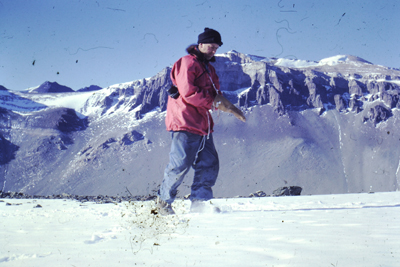
Early in his career he undertook two stints at Scott Base in Antarctica, the first from October1967- January 1968. He then put in the full year 1977-78, first as deputy leader and then leader over the winter months at the base.
Antarctic ice fall 1978 -foto RL
Cape Hallett,
looking across Edisto Inlet
He was a 23 year old in 1967 when he worked as part of the New Zealand Antarctic research programme. Transported  down in a US Hercules he was involved in providing summer support. He was initially occupied with the construction of buildings at Lake Vanda in the Wright Valley. This NZ base was established at this time. Then he journeyed out to Cape Hallett. 

Weddell Seal
This was a joint NZ US Base (now closed). Here he tagged Weddell seals and undertook a census survey. The workers were transported to the colony in a US icebreaker which ferried them in by helicopter for 5 hours at a time.  The census took a week.
Scott Base vista -foto RL
He then took off on his OE for four years before returning to Lands and Survey. In his second stint, from which this selection of images is drawn, he spent a full year on the ice from October 1977 to October 1978.  Here he was seconded to the DSIR as Deputy to Rob Straight, and then stayed on as leader through those long dark winter months.
Scott Base 1978 -foto RL
There were 65 at the Base, then another 65 in the field and he spent the summer managing the field parties, maintaining the radio schedules and overseeing, transport logistics. It was also his job to keep tabs on health and safety, before there was a healthy and safety; a critical responsibility in such extreme conditions.
Dry Valley Antarctica 1978 - foto RL 
In winter all this activity stopped, and there followed the haul through that long Antarctic night until the sun once more lifted up above the horizon. 
Port - McMurdo Sound 1978 -foto RL
It was short walk to the US McMurdo base however where there was always a welcome and this led to some  memorable nights with the Yanks, especially on reaching Mid-winter, and then through July 4. 
Scott Base - 1978 foto -RL
Ridgway used to give a summer lecture on Antarctica in the DoC Summer Nature Programme, which would pack out early, so you had to reserve your seat. He is a droll speaker and one of his  most memorable anecdotes concerned the decision to allow women on the base for the first time. This was taken by a cautious New Zealand bureaucracy which decided to add one female to a party of eleven males as an experiment to see how things went. She had the pick of the party and soon settled into a top bunk with a beau; causing the usual consternation in the rest of the party.

They never sent a woman down on her own again. 
Guiding the tour - Ridgway at Pipiriki - Whanganui River 2006
To be continued…

Track we were listening to while posting this Eddie Cochranes Summertime Blues because, though its mid winter over here, it still feels like autumn or early spring. Is global warming really starting to show its hand down here?

          I'm gonna take two weeks, gonna have a fine vacation
I'm gonna take my problem to the United Nations
Well I called my congressman and he said quote:
"I'd like to help you son but you're too young to vote"
Sometimes I wonder what I'm a gonna do
But there ain't no cure for the summertime blues 

Tuesday, 21 June 2016

The Expressway and the destruction of a New Zealand wetland


Welcome to the Midnight Collective Broadsheet 115
Actively supporting NZ’s endangered wetland birds


This blogpost is for Jo Cox and her family and all those families in Orlando. These tragedies simply underline how small the world now is, how we are all in it together and how shocks like these one's, distress and sadden communities even as far away as this one.

Winter has now set in at the Wharemauku bridge site here in Raumati Beach. The NZTA corporate consortium has pledged  to finish this expressway before the end of the year and it is still too early to tell what the long term effect of sending a Mexican wall like this, trumpeting through the area, is going to be, though the processes of gentrifaction and beautification are getting underway.
Re-excavating the former dune lake
Signs of erosion on the bridge approach
They are not however, going to re-establish  the wild natural area that has been destroyed.
A dog's breakfast - the former dune lake area
On the eastern side of the wall, substantial bodies of wetland are now forming. It is trapped behind the expressway though it is likely that drains will be put in to siphon it into the Wharemauku.  This has happened on the other side of the construction where a large new wetland had formed, but then suddenly disappeared overnight.
Now you see it.
Now you don't!
How this will affect the wildlife is still undetermined. We are no longer seeing the varied populations of fifty to sixty wetland birds and the few we are seeing are generally the top predators. Seagulls are turning up, that never used to visit, and the self introduced spur-winged plover, which was previously rare, has now formed a substantial population. They predate pied stilt and oystercatcher nests. The pukeko are also remorseless predators and very adaptable. A family of 6 or 7 have returned to their old dune lake haunts. Then the Canadian geese, that used to overnight here have also been seen on days when the consortium isn’t at work.
Black swan and pied stilt in wetland on Sunday before it was drained again.
There are signs that other birds are still around because we’ve spotted teal, shoveller and pied stilt, black swan and the injured paradise duck from last year. 
Shoveller - male
Then a rare spoonbill and white faced heron have put in an appearance, but only once again, when there is no work on the site. It is still unknown how the birds will react to the constant traffic, once this area begins to settle again.
Parera-cross pair
What is most concerning is the sudden decrease in the duck population. We counted around 10 down at the beach end of the Wharemauku in April where we would usually find up to two dozen. Usually these numbers halve through the duck shooting season in May, but we have been left with two pair, one of which is parera cross. These two have been paired up since March. Through the courting season ducks are usually careering around overhead, but we have seen none of that behaviour this year.
Against all odds rushes are restablishing in the cleared wetland areas
Nature is a constant surprise however and in the remnant wetland that had been bulldozed out, we suddenly found communities of native wetland rushes re-establishing themselves. These haven’t been re-bulldozed as yet, and we’ll keep you posted on their progress. 

Watch out for our next post which will feature a profile on Conservation veteran -Ridgway Lythgoe- and feature his photographs taken in Antractica in the late 1970's when he led New Zealand's over wintering party...

Track we were listening while we sorted this was Rainy Night in Georgia.  

Hoverin' by my suitcase, 
Tryin' to find a warm place to spend the night
Heavy rain fallin', 
seems I hear your voice callin' "It's all right."
A rainy night in Georgia, a rainy night in Georgia
It seems like it's rainin' all over the world
I feel like it's rainin'all over the world
Brook Benton of course, and Susie’s choice because yes, she is back amongst us and all has been forgiven. 


Jill Studd’s blog

Monday, 6 June 2016

The New Zealand Robin on Kapiti Island


Welcome to the Midnight Collective Broadsheet 114
Actively supporting NZ’s endangered wetland birds


Our local robins, like their cousins around the world, are delicate creatures and critically endangered on the mainland islands. The populations of these native birds declined until a famous last ditch attempt was made to rescue the Black Robin on the Chathams. They were down to their last female -Old Blue- but this species has now been pulled back from the brink, thanks largely to the efforts of Don Merton.
Old Blue - photogrpahed by Don Merton
The North Island robin thrives in pest controlled areas and when Kapiti was cleared of rats  in the mid 1980’s they began to flourish. They are  endearing and fearless, incautiously so, often straying within a metre of visitors making their way along the Island’s tracks.

Amy and Stan Wilkinson who began custodial duties on Kapiti in 1924, noted in their  book Kapiti -Bird Sanctuary how, as the bush cover began to regenerate after the devastating fires of the 19th Century, the Island’s robin populations began to rise.  The chief predator was the ship rat, an immigrant from whaling days, though eggs could also be taken by the long tailed cuckoo.
Regenerating bush Kapiti Island. Mahoe, kohekohe and other broadleaf trees  taking over  the kanuka
In building their nests they sometimes used the abandoned nests of thrush, blackbird or tui,  reducing the size by heaping new material inside. This was then lined with soft tree fern fronds. Like the kakariki and pipit, who are similarly endangered, they often build close to the ground. The female constructs the nest while her mate is occupied with feeding her through this time.  Stan and Amy pick up the story of one nest building they monitored…

 Amy and Stan Wilkinson Kapiti Island
In the latter end of September 1931, we had a pair of robins under constant observation. The nest had two eggs, five feet up in an old hollow mahoe. The hen was sitting while the cock bird worked diligently, keeping her supplied with insects. His beautiful song could often be heard long before we reached the nest. One day the singing had stopped and our worst fears were realised. The nest had been raided during the night. The two birds were in the vicinity and looked very dejected.
Regenerating nikau thicket
However a week later they must have made another start because a nest was discovered on October 13, containing three eggs. This time it was placed in the crutch of a frond. The situation was ideal except from a rats point of view.  The fern was growing at the foot of a bank that was about 10 feet high. The bush was thick and the sun rarely got through. On October 25 tiny young ones were there, having hatched the day or night before. They left home on November 16. They were large and strong but still being fed by their parents on December 25. We suspected the parents of breeding again but it was not till Christmas Day that we discovered they were using the same nest. Two eggs hatched on December 27 though only one of the chicks survived, leaving the nest on February 22. 

A pair of robins lived close to their home (now Red House)  and the female would often come inside to raid the kitchen. These days feeding the birds is discouraged though of course, the birds can't read the signs and never give up trying it on.  
An ever hopeful kaka on the Red House balconey
Susie Niews has gone awol this week so we're sticking with   Patsy Kline and  Half as Much

If you loved me half as much as I love you
You wouldn't worry me half as much as you do
You're nice to me when there's no one else around
You only build me up to let me down
An imperiling rendition of Hank Williams'  wonderfully melancholic lyric.