Monday, 3 April 2017

New Zealand wetland and its motorway - Mixed messages on managing traffic in the 21st Century


Welcome to the Midnight Collective Broadsheet 135
Actively supporting NZ’s endangered wetland birds

Paradise duck and Grey Teal flocking over the recently opened M2PP expressway
The expressway was opened in a fanfare of self-congratulation but after an initial outbreak of universal happiness… (families, we can here reveal, have been traveling from Wellington (60km), to try out the new highway, whilst fighting over who is going to drive!!!)… reality is beginning to sink in.

Instead of clearing the traffic jam into Wellington each morning the expressway has doubled commuting time to an hour and a half, with jams recorded as far back as Porirua (23km). This follows the experience of all major motorway initiatives that simply shift jams to other areas as our roads fill with more and more and more traffic. (Most of our neighbours run two cars, with one having four parked up on the lawn).

In the meantime retail shops are recording significant drops in their monthly takings as the bypass takes effect.

The wetland areas opened up however, continue to provide a very positive story. This area had been designed to drain dry, and this fueled our initial pessimism about the future of the area, but though the area has been completely remade, we are continually surprised by what is going on down here. 
Dunelake prior to expressway excavation
Dunelake from google, prior to excavation
Excavations underway showing greatly enlarged areas. The green paddocks on the upper right are now a metre or more above the brown areas in the centre.
This area is usually dry between late January and early April but we now have water all year round. Because of the very wet summer (and now autumn), it is too early to predict this will be permanent, but in talking to one of the managers on site, it is clear the NZTA is also surprised by the permanence of the wetland area  opened  up. Their theory is that the area has been excavated below the local water table and if so, then this is likely to be permanent. The settling of the rear areas also appears to be aiding this with back flow occurring (outside the floods). 

The birdlife is showing its appreciation and appears not to be affected by the traffic flows close by. We now have wetland either side of the new road and while the original dune lake could host up to seventy birds, we have been sighting double this number, though their species variety has changed.
Paradise duck roosting- Western side of x/way
Paradise duck (up to 40) have settled permanently here since January, then mallard and parera-cross  ducks (50). Another prominent waterbird is the introduced Canadian goose, but what we are most delighted with is the colony of grey teal which were previously rare visitors.
Grey Teal roosting - west side
Around  twenty teal seemed to have found a base  here and they flock at times, mixed in with the paradise ducks (Putangitangi). Up to four pairs of pied stilt have also been resident over this summer. They have bred well  this year and  all going well, we should see more pairs of these elegant waders next year. 
anxious pied stilt parent investigates the photographer - x/way to left
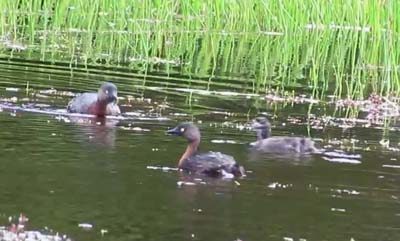
One royal spoonbill seems to visit regularly but we still haven’t seen the rarer birds – scaup, shoveller, white faced heron and then the dabchick, while the local frog population has completely disappeared; though perhaps these will also return over time.           
Plantings on the east - mid December 
Same view a month later
The area has been replanted with local native species and here major problems are developing with weeds. This dune area provides extreme conditions with a swampy winter/spring and then drought-prone summers. We remain sceptical about the success of these plantings though they are off to a great start with the wet weather. However the weeds are making an even better start and here’s the evidence, above and below.
Dunelake west - rear mid December
Same spot a month later - weeded up
The NZTA are committed to a four year programme of weed control, when the natives should have developed a canopy to inhibit weed growth. We have experience in managing weed control programmes however and the moment you stop consistent  work on them is the moment  all your hard work slides into reverse. There are signs of weeding and spraying going on but it isn’t making much impact on the weeds in the lower reaches, although in this photo (below), the native rushes can be seen making a comeback and helping out. They should grow to dominate this area.
This channel appears to be draining the wrong way with wildling native rushes back taking over  
Meantime, here is another sign that the seasons are out of joint – a wary black swan female with her cygnets in mid-March (autumn over here), at Ratanui wetland. The father is out of the picture.
black swan family - Ratanui
Track we’ve been listening too while posting this? Well, we’ve been falling for Little Richard, all over again, because isn’t he adorable…  
Well, I saw Uncle John with long tall Sally
He saw Aunt Mary comin' and he ducked back in the alley 
oh baby 
Yeah baby, woo baby
Havin' me some fun tonight, yeah, 
Havin' some fun tonite.


Sunday, 12 March 2017

Yet another flood on the Kapiti Coast


Welcome to the Midnight Collective Broadsheet 134
Actively supporting NZ’s endangered wetland birds
Royal Spoonbill, very early Sunday morning views the flood with approval...
We are cramped for time but putting up this quick post of fotos of yet another flood through the Wharemauku creek this weekend.
Wharemauku spills its banks 8.30am Sunday morning
Something is definitely going rogue in our weather patterns because we have been watching this area for 5 years now and floods like this one used to occur every two years. We have had four since September 2016.   
Height of the flood Sunday lunchtime
Fourth time since September
We recorded 120 mm of rain over 36 hours and once again the entire area on both sides of the now open expressway were flooded as the waters rose through the Saturday night and then flooded through Sunday.
A rough count came out at 140 birds
The very positive aspect of all this is the return of waterbirds to this area. We counted 140 paradise duck, teal and mallard along with . This is in the early morning when we also spotted the royal spoonbill (above). 
3 Welcome swallows rest up during flood
While black fronted dotterels seem still to be around.
Black-fronted Dotterel back at the wetland
We’ll be looking in more depth at these developments in new posts.

Sunday, 26 February 2017

Flocking terns, poaching and political skullduggery at Kapiti's marine reserve


Welcome to the Midnight Collective Broadsheet 133
Actively supporting NZ’s endangered wetland birds

flocking white fronted terns on Paraparaumu Beach
The pleasure of living close to a marine reserve is amply demonstrated in this large gathering of white fronted terns, that over the past week have taken up residence on this coast, and are following schools of fish, shoaling through the reserve.
In flight
Something must be going right to find such a large congregation which, as these photos reveal, includes many adolescent birds.
Rested up
adolescent
We counted 216 squatting on the beach, then the next day they were back in even larger numbers. They feed off-shore with gulls and shags. Then, no doubt, larger marine fish like kahawai and kingfish are following in train, under water.
Southern section of Kapiti marine reserve. Island in background
Yet these reserves remain under constant threat, not simply from a government that might reverse or modify protecting legislation (as has been threatened in Australia), but also from illegal fishing.  In the days when we were involved running tours to Kapiti Island, cynical visitors observing the thick beds of regenerating paua (abalone to our overseas visitors) would joke about DoC staff helping themselves. (It never happens.)

And there is always the threat of illegal fishing. Here is a shot of a fishing boat, testing the law by running its nets right along our reserve’s northern boundaries.
Fishing boat trawling along northern edge of reserve November 2015
There is little to stop a boat like this dropping its nets into the reserve while travelling through the strait at night. What is also concerning is this net, set out on the beach in the middle of the reserve last Sunday lunchtime, with neither qualm or a fishery inspector in sight.
Hand held net, foreground 
net floats (detail)
Why? Because the government isn’t providing the funding to properly police this activity.

There is a worrying level of worldwide cynicism about governments and the ever widening gap between what they say and what they do. Having announced the laudable, but harebrained objective of ridding this country of introduced mammalian pests  within 50 years, (that doesn’t include the humans); it is now going to clean up our rivers within 40.

Noone believes this because... 

Is it achievable? No. Is there an election coming up. Yes. Are the Greens polling strongly. Yes. A hung parliament looks a strong possibility which explains why a government that’s spent the best part of nine years now,  trying to repeal the RMA (the legislation that puts environmental protection around development), disembowelling the Department of Conservation, and turning our Environmental Protection Authority, (Look Out America!), into the hand maiden of business interests, is now trying to green itself up.

The good thing about making lofty pronunciations on the environment is that they carry primetime coverage without giving time to look at what the detail might involve; which always comes down to how much money is going to be put into realising it. Which is why someone can happily place a set net in the middle of our marine reserve without having to worry about the consequences. There is no money to police it.

Massaging the truth in this way is a tried and trusted political strategy but it only works until you get caught out. It was through the risk of epidemics in the 19th century that New Zealand developed a co-ordinated public health system very early; but only on paper. It was passed into law but never adequately funded; the healthy wealthy (who ran the country) drawing the line at funding the healthcare of the poor.  Epidemics showed no respect for wealth and class boundaries however and following public panic when the news broke that plague had arrived in Australia, suddenly there was ample cash to begin developing the full cover public health system we have today.

So what is it going to take to protect, fund then police the legislation designed to guarantee the quality of our unique but now threatened environment?

Track we were listening to while posting this... Well in lieu of a song we are putting up this link  to  a column in the New Zealand Herald we thought you might enjoy...We dare you 

Environmental artist Jill Studd's blog
Contact Us 

Monday, 13 February 2017

A New Zealand dabchick family -Feeding the youngster


Welcome to the Midnight Collective Broadsheet 132
Actively supporting NZ’s endangered wetland birds
Discovering intimate wildlife moments is often a matter of chance; the finding of yourself in the right place at the right time. You stumble in on them and that’s what happened here, on one of the rare fine days of this summer. (It’s persisting down again right now, as we send this to air, with NSW across the water, in a heatwave emergency.)
Regenerating swamp forest wetland -QEII Park Kapiti
We were visiting the QEII park wetland restoration (above), about 10 km south, where two families of dabchicks have been in residence since last year. These charming little endemic grebes don’t usually tolerate each other, especially during the breeding season, but while one pair were busy feeding a rapidly growing chick, they simply ignored the other pair frolicking close by.
Young dabchick pair
We managed to shoot this lengthy video of the two parents in action at the end of which the chick was so sated, that she sat herself down on a floating clump of weed to rest up.
Both parents contribute to the feeding though the mother (the smaller and less coloured of the two parents) is noticeably more successful in fishing up food. It was she who kept coming back to check the youngster as she settled in the centre of the lake.
Dad brings home the bacon -Mum in the foreground
This chick is almost ready to begin to dive on her own and was occasionally following her parents in putting her head under water and steering around with her webbed back feet on the look out herself for food.
All done - chick at rest on water
Having two parents actively involved in feeding and raising youngsters must have a positive impact on their survival (when they come off the nest it is usually the father who carries the brood on his back). There is increased competition now as the Australian émigré coots begin to gain a foot hold locally.
Coot at Ratanui wetland
They are aggressive and the dabchicks are wary of them when around, but the population in this area seems to be holding its own.

Track we were listening to while posting this – The Weavers  I’m standing on the outside of your shelter …

I'm standing on the outside of your shelter, lookin' in
While the bombs around are falling everywhere
Inside you look so warm and safe, and oh so happy
Have I ever told you that I care?

This is from The Weavers  Carnegie reunion May 1963... Better start digging them again.

Saturday, 4 February 2017

Bummer of a New Zealand summer…yet another flood hits the Kapiti Coast


Welcome to the Midnight Collective Broadsheet 132
Actively supporting NZ’s endangered wetland birds

Shelter from the storm - a fledgling welcome swallow takes a breather
The headline in today’s paper ‘Bummer of a Summer’ was not designed to sell newspapers, but certainly sums up our summer. Every week a new front has swept through, thwarting what should be the holiday season. It’s now only three weeks to autumn and  thursday dawned promising enough, though the forecast said otherwise. Another storm was steering through the centre of the country. By 10am it was drizzling; by lunchtime it began to mean business. This weather was coming down from the nor’west, so it was warm with it and forewarning gave us the opportunity to try and understand what was happening to the wetland as our Wharemauku creek began to rise.
Midday and going down the gurgler. The Wharemauku begins to reverse flow, back into the wetland
It got pretty rough out there through the afternoon -the wind climbing to 60 knots and more, so picture quality from under a complaining umbrella began to deteriorate, though here is a visual account of what happened next. 
Wetland West -This photo was taken after 20mm of rain.
Backfilling of the wetland is just beginning
Rainfall topped 60mm (3inches) over the next 9 hours. This was less than the floods of September (110) and November (85), but the flooding nevertheless was comparable. 30mm had fallen by 4.30pm, then 50mm as night began to fall. By dawn it had topped at 60mm, but the Wharemauku was still running high.   
Wetland West around 5pm - after 30 mm
 
Wetland west at 50mm and height of flood -7.30pm
 
Wharemauku breaks its banks 
Same time from under the expressway bridge
Similar flooding was occurring on the other side of the expressway 
Wetland East after 30mm around 5pm
Spot the difference 3hours later -just before dusk.
Wetland West -Dawn the next day after 60mm.
We are beginning to form a picture of how this flooding is going to affect this area. The Wharemauku was rising through the afternoon but it wasn’t until rainfall hit 30mm that flooding became general through these areas. But this happened very quickly after the rainfall topped 30mm. What has been surprising is to see these two year floods occuring  every two months. Though before the expressway drained the area,  the stopbanks would have coped comfortably with this level of flooding.
Marooned - a lone pukeko makes a break fro higher ground 
 
Flood at its height from the other end of the wetland -bridge in far distance
This area has been entirely transformed, and we still don’t know what the long term effects will be. The ground level has been substantially lowered, perhaps below the water table. It would normally be dry this time of the year and this may have turned the area into a permanent year-round wetland. This is very good news for our wetland birds who have already begun to descend on the area. In the former dunelake there was a mixed population of 60-70 birds. On our morning trip after the flood, we made a rough count of 130.
38 ducks come into land on the now flooded plain. And this was only half of them.
A new seasons gathering of paradise duck youngsters -putangitangi.
And this was only half of them. (Grey Teal in front.)
We don’t have the species variety of the old swamp, but this may come over time as the area begins to look uncannily like the original Wharemauku swamp of 120 years ago,  minus the forest of course and with an expressway, carving it in two.

Track we were listening too while posting this rebel song from The Clancy Brothers and Tommy Makem Kelly the Boy from Killane.
What winds from the south brings a messenger here
Of a hymn of the dawn for the free

Sunday, 22 January 2017

The Breeding Season 2 - More good news from our New Zealand Wetland


Welcome to the Midnight Collective Broadsheet 130
Actively supporting NZ’s endangered wetland birds
Squadron of mallard ducks western side of the expressway
What it doesn’t pay to do in conservation, is try and second guess nature and we’ve been caught doing just that. No sooner had we registered our  concern about the disappearance of ducks from this area than a squadron turned up. This was late Friday afternoon, down at the far end of  the western side of the wetland. We couldn’t get too close, but they were primarily new generation mallards without their mature colouring, their mothers still in tow.

These protected grey teal (adolescent in front) still loose 6%
of their number during the duck shooting season 
Mixed in with them however was another good news story, a family of grey teal. You can tell teal apart from ducks, not only because they are smaller and differ in colouring, but the parents stay together through the breeding season. So if you see two together with youngsters they are usually teal. We have seen this  behaviour also in our very rare and endangered native duck -parera, but mallard mums all go solo at nesting time.

Grey teal
We remain mystified by our summer weather. It appears as if spring has simply carried on though January with a series of southerly fronts steaming across these islands during what should be beach ball weather.  Another 20 mls of rain again last night (with winter snow on South Island ski fileds), has marred the holidays of many, but is great news for the wetland. It is carrying a lot of water for this time of year, when it is usually drying up.
Royal spoonbill eyeing up a young mallard male
It is also regularly attracting this royal spoonbill. He is surprisingly dirty however which is a bit of a worry because it usually indicates a sick animal.
Royal spoonbill shaking out
In our last post we featured three pied stilt chicks which were first observed in mid-November, so are pleased to report that all three have survived and are now starting to put on their mature coats. 
Pied stilt chick - mid-November
Nearly there. -Pied stilt chick mid-January
And another...
And another
They are domiciled on the eastern side of the expressway and still under the care of their parents.

Finally a couple of shots of pukeko from the Ratanui wetland about 4 km away. 
Whoops - pukeko takes guard...
It is always difficult, and often  foolhardy to try and fathom odd  animal behaviour, especially when it is difficult telling the males from the females. When this pukeko  kicked up a  fuss as we tripped over each other, however our curiosity was aroused. Sure enough, shortly after, a companion came barrelling out of the brush, did a double take at the intruder and headed off in the opposite direction. 
Pukeko interrupted. They carry food like this holding it with a clawed
foot, while stripping the succulent juice. But this is a dry twig. 
She was carrying a large dry sprig  in her beak (you can tell the genders apart by the shape of their beaks but we're nt absolutely sure about these two, as the males usually do most of the sitting on the eggs ); so our surmise is that they had begun to build a nest; probably their second this year.     
self-explaining
With the entire globe getting out on the street to register its communal anxiety about what’s going on in the US, we were playing a song for our times in support of that while we posted this – Frank Zappa and the Mothers…   Trouble Coming Everyday
Well I'm about to get up sick
From watchin my t.v.
Been checkin' out the news
Until my eyeballs fail to see
I mean to say that every day
Is just another rotten mess
And when it's gonna change, my friend
Is anybody's guess
So I'm watching and I'm waiting
Hopin' for the best
Even think I go to praying
Every time I hear them sayin'
That there's no way to delay
That trouble comin' everyday