Wednesday, 29 April 2015

White-faced heron in New Zealand


Welcome to the Midnight Collective Broadsheet 73
Actively supporting NZ’s endangered wetland birds 
White-faced heron -Pauatahanui inlet
We haven’t seen a great deal of this elegant and graceful bird over the past summer  but in the last week have managed to run into three –one at the Waikanae River then two more down at the Pauatahanui Inlet where there are sometimes up to 5 birds though they remain loners and unlike the spoonbills, are rarely seen feeding in groups.

You get a sense of how scary it must be to be inanga (small sprats) or frogs, waiting in what you think is adequate cover  as the sleek, fierce shadow of this bird with her x-ray vision comes stalking passed. We have left our film silent to try and gain a sense of the grace and peacefulness you find in wetland areas though at the start of the Waikanae section you can see the bird hoist an inanga out of the river and flick it up then swallow in one movement, spraying off the water. We had trouble keeping up with it. Then there were people and dogs walking along the opposite bank and that is what is causing the bird to bolt into deeper water. 

A heron used to be a regular at the dune lake and then, through autumn you might run into one feeding in the Wharemauku creek or at the back of the airport. We haven't seen them however, since the expressway excavators got going. A female would bring her fledgling down to feed. She looked pretty exhausted at the end of the breeding season and was initially very shy, but then seemed to get used to us hanging around with a camera. There was always plenty of food, which is the main attraction but being such big birds they are vulnerable to dogs, especially when they take it into their heads to get down into the creek. Yet we never saw one in trouble; nor any of the shags that also haunt the creek around this time of year.
White-faced heron feeding in the Waikanae River  
We have used a photograph of one of these herons perched in a stand of california pine (radiata), as a flyer for the plight of this rare dunelake. But now the birds have gone and so to, the stand of pine an indication of how quickly this haven is disappearing.

I will go to watch the animals, and let
something of their composure glide
into my limbs - Rainer Maria Rilke 

Tuesday, 21 April 2015

Autumn in New Zealand - an update


Welcome to the Midnight Collective Broadsheet 72
Actively supporting NZ’s endangered wetland birds

The days are now beginning to close in, with a very early cold snap bringing hail showers to Auckland and leaving snow on the Desert Rd (Centre of the north Island). So we are starting to get a taste of wintry weather, though it remains unusually mild.
NZ scaup pair at dune lake
Still, local birds are not deceived, with both pied stilts and now these scaup having packed up and left. Most of the waterbirds begin to flock this time of the year and we found 20 or so scaup banding together at the Waikanae estuary, just prior to their leaving. It remains a  mystery as to where they go, though Lake Taupo might be one destination. We haven’t seen a lot of the stilts this year (one pair in October looked very broody at the back of the airport, but decided against it), so we didn’t notice their leaving; but the scaup departed in early April.
Grey teal - Ratanui wetland
This colony of grey teal will stay here however and had gathered to sun themselves at the Ratanui wetland. They are noticeably less aggressive in their mating behaviours than introduced mallards (like most of our native waterbirds) so paired up couples were hanging out with the colony. 
Grey Teal - tete pair
These animals however will soon be decimated because  the duck shooting season is approaching and here we get an idea of New Zealand conservation in practice (rather than theory). This bird is a protected species, but 6% of the population is still shot during the season.      
Young grey teal - tete
We remain concerned over the fate of the dabchick pair at the Waikanae estuary. 
Lone dabchick-weweia at Waikanae loagoon
We have only seen one bird in nearly three months now though another lone bird has settled at Ratanui. 
On the lookout - lone dabchick at Ratanui
This delicate little grebe previously hung out with the family of scaup there which tolerated rather than adopted him;  but following their departure he is now left with a small group of coot. This recent Australian immigrant is very territorial (like Aussies themselves) and the dabchick was steering well clear.
A NZ icon amongst the sails at Thames
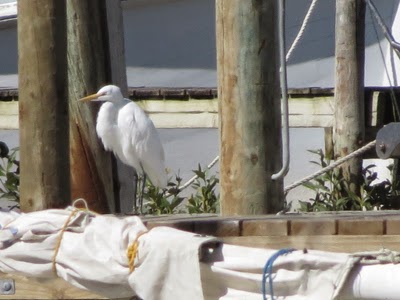
Finally an image of another kotuku – this one sailed in from the Hauraki Gulf onto a footbridge down at the Thames wharf…It seemed quite at home here in the local marina though home is 1200km away at the Okarito Lagoon Westland.   

Track we were listening to while posting this Siouxsie and the Banshees - This Wheels On Fire

If your mem'ry serves you well
You'll remember you're the one
That called on me to call on them
To get your favors done
And after ev'ry plan had failed
And there was nothing more to tell
You knew that we would meet again
If your mem'ry serves you well


 from Bob Dylan and Rick Danko of course - which really dates us (sigh)...
Jill Studd's Blog 

Sunday, 12 April 2015

Why would you bulldoze this?


Welcome to the Midnight Collective Broadsheet 71
Actively supporting NZ’s endangered wetland birds

This magnificent Royal Spoonbill was pictured feeding (with two others out of picture) 5 minutes walk from the centre of a town keen  to identify itself as The Nature Coast. 
It’s a short 20 minute boat trip to New Zealand’s premier endangered bird sanctuary Kapiti Island. Here they have started a colony and they fly across the strait to feed.

This dune lake used to be one of the few safe wetland areas where this bird could do so in reasonable safely in the centre of an urban area. At the height of the season there is a lot of food in this lake where five of these birds have been seen fattening themselves up at one time.

They seem to like it here and would have proved a major drawcard for local people and visitors alike, had the wetland been recognised and protected, but its too late now because they haven’t been seen since early January 2014 when the Expressway excavations got underway in earnest.

They have been spotted feeding in a retirement village pond down by the coast however, though this is a much more perilously enclosed habitat for these large birds to get in and out of, and they are much more at risk from harassment by dogs.

So we are stumped too!

Track we were listening while posting this? Well, hasn't been a track at all, but wall to wall Coachella on a 46inch screen and high density sound in the dark with curtains drawn and right through the day –Ok we agree, it is shameful, but we simply can’t help ourselves anymore and don’t even try to. This is the first time its been beamed all the way over here from California where you might almost think you’re there though even with five screens we couldn’t keep up with everything and missed Royal Blood while still hoping to catch them on a replay; but goodness knows how those on the ground manage to get round everything when we couldn’t. Enough already! Our pick for who got away with the top prize is Run The Jewels who have a chemistry that couldn’t be bottled try all you might, for it flows right through everyone on stage and then into the audience at large – though hey! we couldn’t hear most of the words which is probably just as well – We are rock and roll people however and Jack White should have walked away with this one by a country mile but he’s turned into such a flawed human being that we didn’t want to encourage him any further because, though  we all have our moments we try a little harder, than he seems to want to; the next time around…

And it’s now Monday over here but we’ve  still got a day to go, so we’ll be staying right where we are.

Jill Studd’s Blog
Contact Us

Tuesday, 7 April 2015

Autumn comes to New Zealand Wetlands


Welcome to the Midnight Collective Broadsheet 71
Actively supporting NZ’s endangered wetland birds
It is nearing the middle of autumn and though it still remains very warm (22oC most days) over the last 24 hours we have had out first substantial fall of rain for quite some time. It has cleared out the clogged Wharemauku and should have started filling the dune lake so it is going to be interesting to see how the expressway consortium cope with it, digging through one of the deepest and wettest deposits of peat on their route.

New Zealand Scaup - a diving duck

Meanwhile we are seeing the usual prickly behaviours as many of these water birds begin pairing up. The pied stilt and the NZ scaup however are starting to gather in larger groups in preparation for returning to their winter quarters. The stilts were spotted in numbers on a beach about 30 km to the north, while the scaup are clumping together into larger communities on lakes in the north of the town. We mentioned last year that we counted around 100 on Lake Taupo and though we are unsure where ours are heading to, this is one area where collect in order to overwinter and select a mate.
Pied Stilts
We have been concerned over the fate of our local dabchicks for although the pair at the Waikanae estuary have raised one chick we haven’t seen the two together for some time now, while a lone youngster has settled at the Ratanui wetland. It is unfortunate that a family of coot has also taken up residence here. These are an aggressive Australian import – a fierce competitor with dabchicks and scaup which are much shyer (and more alluring) birds. Whenever the coot are near the others are always on guard and ready to make for the safety of the raupo.

Dabchick (small NZ grebe)

Track we were listening to while posting this – It's an album Blue – and Joni Mitchell –who else – We’ve been more than a little anxious about this last week…

Monday, 30 March 2015

How Do Birds Think?


Welcome to the Midnight Collective Broadsheet 69
Actively supporting NZ’s endangered wetland birds

There is a wide range of opinion about the character of the minds of animals; a discourse that travels from complete denial to woolly romantic assumption (and further). All this sooner or later washes up against Thomas Nagel’s  famous 1974 philosophical paper -What is it like to be a Bat? which declares unambiguously that we’re never going to know. 
Expressway excavations poised above the dunelake
But there are degrees of knowing, so keep your eyes open in a real world and it is surprising the insight that can bring. We were down at the dunelake documenting its destruction, when a flock of Canadian Geese came winging over.  Like most of these wetland birds they spend quite a lot of time in the air this time of the year (reasonably early autumn) and here were two squadrons of around 15 birds each, the one in close pursuit of the other heading straight for the dunelake.
A Candian Goose surveys her flight path
On their approach however, something went wrong (It was a clear windless day) as the lead birds suddenly switched direction right over the dunelake, a change of ‘mind’ that took the following birds completely by surprise. These are big ungainly animals that carry a lot of forward momentum so they can’t change their flight paths easily. For a brief moment there was tumult in the rear as they all adjusted in their own way, to the new GPS instructions from the leadership, while trying to avoid colliding into each other. They were rolling and twisting in what came close to  pandemonium, though soon smoothed out on the new flight path and continued chugging along as of nothing had happened.
Canadian Geese in controlled flight
How could we read this?  Well, the dunelake begins to fill around mid-April,  but it isn’t really habitable for this size of bird until June so while the birds seemed to  know the lake, they were a little out in expecting to be able to land on it.  This in itself, is an interesting disclosure - that the birds don’t wander  around on the off chance, looking for food and refuge. They know this region and knowingly track from one wetland to another. This indicates of course, a condition of mind, though we'll never get inside one to  confirm it. (Canadian Geese  don’t breed or usually feed at the dunelake but use it as a night refuge in winter.)   

But were they actually intending to land?
UK - Starling flock

Another introduced bird starting to flock this time of year is the  starling. These birds are a nuisance on Kapiti Island because they tend to overnight there and drop weed seed (in their droppings) on this regenerating native reserve. Be that as it may, if you have ever seen starlings manoeuvring in a flock in autumn you will know what an extraordinary sight it is. Their co-ordinating balletic rhythms come close to the uncanny. Though Canadian geese also make a grand sight, boating along in formation,  usually at very  low altitude, they don’t exhibit anywhere near the same  inflight flair.
Yet they are usually more co-ordinated than this narrowly avoided midair pile up would suggest.  So what might be going on? The question it raises is about formation flying. Is this innate to a young goose or do the parents go out and teach the youngsters how to do it. And was this happening here? They look effortless enough when you see them overhead but this calamity  shows that it's every bit a highly complex technical skill as that of our own aerial acrobatic teams. And that it requires a high level of concentration  in a community of effort.
So was this an inflight training exercise for a new generation of young geese, led by senior members of the local community? And did they deliberately dip over the (now dry) lake to orientate the youngsters. Had they no intention of landing? If so then this has further implications regarding the communal lives of these birds because here were a group of adults working to blood in their youngsters. 
Current theory would usually regard this behaviour as instinctual - ie young animals following their parents - but here much more complex parenting behaviour appears to be going on. One scientific thinker working in this area of animal minds, while trying to dig her colleagues out of the behavioural hole they still seem quite happy to be wallowing around in is Barbara Smuts. We recommend you follow her up. Better still,  get out there and start  piecing it all together yourself.
Track we were listening to while posting this -Jimmy Reed -You Dont have To Go  
Whoa Baby
You dont have ta go
Whoa Baby
You dont have ta go
Gonna pack up baby
 Down the road I go 
Jill Studd's Blog
Contact Us

Tuesday, 24 March 2015

Critically endangered New Zealand duck sighted as bulldozers roll in


Welcome to the Midnight Collective Broadsheet 68
Actively supporting NZ’s endangered wetland birds 


The Expressway juggernaut got its timing spot-on as it rolled over, and then through, our wetland observation lookout, taking around 48 hours to complete its demolition. 
Dune demolition dunelake in foreground 
Last time they were down here, they put on a big show of looking for endangered species, but that’s all history now with the General Election having come and gone. And this  is ironic because 100 metres away we photographed this critically endangered New Zealand duck feeding in the Wharemauku.
Parera female -Wharemauku creek
This is a young female parera and pure bred (Can you identify why? See below). We have been trying to extend our investigation in a wider net through the district in an effort to pinpoint where these pure bred birds are flying in from. Our closest encounters  have been up in the forest wetlands behind us (Tararua’s). That’s a good 40 km away; but these animals are very migratory and can fly in from as far away as Australia and the Pacific Islands, so it’s a bit of a guessing game.
And this time of the year all these ducks –mallard and parera- take to the air in what appears to be a social ritual as they begin to pair off. But there doesn’t seem to be anywhere near the number of birds around this year as usual. We’ve counted five ‘residents’ up one end of the Wharemauku where theres usually a dozen or more. You have to get up around dawn to find them when they are still on the creek – they generally clear out when locals begin walking their dogs along the path.
Botulism has been spreading through our local water birds with sick birds including shags, ducks and paradise ducks, being picked up in the middle of summer when they should be at their healthiest. They contact this from algal bloom in local ponds that stagnate because they aren’t properly drained. We found two young, fully grown ducks dead on the water over recent days. All this has been of great concern and may account for the drop in numbers; though as we have previously mentioned the bird numbers in this area seem to have dropped dramatically since the expressway excavations began in earnest.
Yet inanga in the Wharemauku haven't been affected so far. 
Strange ways - spot your inanga 
This year these little fingerlings are out in squadrons. They live at the bottom of the feeding chain with shags, heron, eels et al, all fattening themselves up on them, along with the kotare (kingfisher) that disappeared in spring but is now back again on its roost near Drain 7, at the back of the airport. We were hoping for a family from this guy this year but it wasn’t to be; though he’s busy now, scooping up the local marine inhabitants from the creek.    
These inanga seem to spend a lot of their time engaged in what looks like ‘play’. Once again the best time to see this is around dawn on a still clear early autumn morning. Here we filmed them in groups, standing on their tails with their mouths out of the water, apparently gasping for air. 
We are completely mystified and though you can’t see too much detail in our clip, we thought we’d post it anyway. These tiny fish are very skittish and as we leaned over the creek bank they scattered in alarm, but soon came back into position once they’d got used to us.

Then finally, here are the telltale signs of parera – green speculum  and brown feet. Just by way of a caution - there is a considerable degree of the usual eyewash on the internet about this bird - including from the 'experts' a result of talking too much to your laptop. Best get out there and start observing them for yourself...
Feet and speculum of parera
Track we were listening to  while posting this the peerless Leadbelly – Ain't gonna study war no more – which we think should be getting a lot more airtime now half the world looks determined to resort to arms once again.    
I'm gonna lay down my sword and shield,
Down by the riverside
I'm gonna lay down my sword and shield,
Down by the riverside
Study war no more

I ain't gonna study war no more
Ain't gonna study war no more
I ain't gonna study war no more
Ain't gonna study war no more
   
Jill Studd's Blog
Contact Us


Sunday, 15 March 2015

Wild Wild Weka


 Welcome to the Midnight Collective Broadsheet 67
  Actively supporting NZ’s endangered wetland birds

One of the most debated issues in world conservation at the moment is how to re-introduce endangered wild animals into settled farm and urban environments. Much of the publicity has centred on inceasing populations of wolf, bear and puma et al, in North America, and then the reintroduction of the wolf in Europe and wild foxes in London. Here in New Zealand we don’t usually think of it as an issue in the same way, but as pest control becomes more common and with protected areas now seeding vulnerable rare birds into cities and towns, we are beginning to hear more of our own variant on it.

What a pleasure then to find weka starting to repopulate urban areas in Nelson town.  We live in the North Island where the wild weka population is down to around 2000, and you won’t see them outside of protected reserves. On the West Coast of the South Island however, and in Nelson you can occasionally stumble over them. These large rails are endemic to New Zealand with four subspecies and these photographs of a Western Weka were taken on the Marlborough coast, east of Nelson.


They can be troublesome because, like the pukeko, they will predate rarer birds when settled into protected areas. One was found for example, on Kapiti Island, predating an egg of the very rare Little Spotted Kiwi while the (male) parent was sitting on it. This is why the populations have sometimes to be managed, by transference to less vulnerable areas.

We’ve been lucky enough to spend time overnight on Kapiti Island and both kiwi and weka have a similar noisy call. If you are out before dawn, you will hear the kiwi screeching back to their burrows, (kiwi are very difficult to see in the bush in the dark even when you are only a few feet from them) but then the pitch will change as the weka’s awake and set up their own strident din. Perhaps these birds use this sound in ways we are only just beginning to suspect, to orientate each other.

Going
In Nelson we stayed in an area sometimes visited by weka, but in the way of these things, we were never home when they forayed out. Then we got an urgent call around six o’clock on our last evening as one came down from surrounding scrub to fossick for food. It was immediately clear we were dealing with a wild animal. Many urban pukeko are now used to human presence and hang around ponds waiting to be fed, but this one shied away from human contact. She hoovered through the garden shrubbery then shot off over the road, so that we despaired of getting a shot of her; but finally did.
Going

Locals say they’ve encountered two families this year, one with five youngsters tagging along. And despite local predators which include dogs, cats, rats, stoats etc not to mention karu (native hawk) – they all survived.

The Nelson Department of Conservation are well aware of this influx and get contacted by concerned locals all the time. They attribute the increase to community run pest control programmes which has boosted native bird populations in the town overall and encourage people to live with them. 

Gotcha
They can be troublesome however, scrounging pet and chook food and getting into the veggie garden; so recommend locals take evasive action to limit their access. They wont disturb these birds however regarding them as part of our natural ecosystem. And this is the kind of balance wildlife authority’s are trying to strike all over the world…

Thanks to Rosemary, Carol and Trevor for photo’s and keeping on the look out.

Track we were listening to while posting this…  Kinda Fonda Wanda  a classically affectionate Neil Young pisstake…
           Well, I went with Mary Lou
           Tried Peggy Sue
           Had a date with Donna
           And Barbara Ann too
           But I'm kinda fonda Wanda.
            Kinda fonda Wanda.

Jill Studd's Blog
Contact Us