Thursday, 24 July 2014

Postscript to the last post


Welcome to the Midnight Collective Broadsheet 33
Actively supporting NZ’s endangered wetland birds

With three days of a southerly storm buffeting the Coast and survey work called to a halt around the dune lake it gave us a chance to get out and scope the work being done. 


Trench 1


Trench 2
The surveyors are accessing the area from the town end and using a large front- end loader to dig out a series of trenches. These are beginning to fill with black swamp water and appear to be cross-sections across the planned expressway.

With a major sewerage pipeline running through the southern end of the area, they have also been marking out pipelines and ventilation shafts the expressway will need to cross on its way north. Now with the sun back out and relatively calm the hive of activity has returned though it continues to be scoping work.

Front end loader tracks to earthwork far end of dune lake July 25
Hay packing at earthwork far end of dune lake  July 25 
Despite the turbulent weather, with snow now thick on the back hills, it has brought only an inch of rain and the dunelake is around a month behind in filling for the year. At the same time there are early signs of returning migrant birds. We spotted a pair of grey teal-tete, not seen since January on Andrews Pond a companion wetland about a kilometre from the dune lake and then our first returning scaup-papango pair. 
Grey Teal - Tete  July 23
Both were heading into shelter from the bitterly cold wind and the squadron of mallards that were busy harassing each other and these birds too, whenever  they got in their way.
NZ Scaup - Papango  July 23
Another sign that we have passed the solstice were a pair of pied stilts seen  on the wing at the back of the airport. The female swooped in close to pick up a piece of feathery flotsam so it looks as though they are going to try for an early nest. Conditions were blustery however and so we couldn’t get a picture – however we’ve been out most days since and hope to run into them again.

Track we were listening to while posting this Can't Take My Eyes off You    - from Jersey's own Four Seasons...
Pardon the way that I stare
There's nothing else to compare
The sight of you leaves me weak
There are no words left to speak

Monday, 21 July 2014

Welcome to NZ where the smell of the environment is 100% Pure (and rising)


Welcome to the Midnight Collective Broadsheet 31
Actively supporting NZ’s endangered wetland birds
Kapiti Rd Flyover
Excavations began last month, about a kilometre away from the dune lake, at the Kapiti Rd intersection. These seemed limited to a flyover exchange and realigning the underground cables  along this main thoroughfare.

Survey party dune lake env
Survey party dune lake environ. 
Within the last week however surveyors have been out in the area surrounding the dune lake to place marker posts that define the extent of the earthworks. These indicate that the NZTA, off its own bat, has swung the road much closer in to the residential area than it had declared to the Board of Inquiry.  The road will be on a 20 foot high embankment, so the passing traffic will now be cheek by jowl with their kitchen windows. It will also completely obliterate the dune lake, from which the original proposal was going to slice only .2 of a hectare.  
Survey post indicating extent of earthworks lies at western end of dune lake 
We are currently seeking the details of these changes and under whose authority they have been made, though we aren’t holding our breath for a straight answer. As it has gathered momentum this project has become something of a law unto itself, underlined by the fact that the NZTA and its partners have stopped posting weekly updates in the local paper.
NIWA pollutant monitor July 2014
Meanwhile NIWA has been maintaining its usual high standard of pollutant detection and we have been monitoring a new red pollutant that has been leaching from Drain 7 into the Wharemauku. We haven't been able to source it as yet, but the finger of suspicion points directly at the NZTA and its partners, for the stain colour matches the rock fill that has been dumped on the expressway over the last few weeks.
This pollutant won't however, be picked up by NIWA because it is leaching out into the Wharemauku below their monitoring equipment. So welcome to NZ – where the smell of the environment is 100% Pure (and rising).

We posted this in silence and disgust at what’s going on in the world today – in Palestine and Ukraine and Tripoli, against which this looks a very minor flap. Our thoughts and prayers go out to the victims and their families. 

Thursday, 17 July 2014

Fishy Business


Welcome to the Midnight Collective Broadsheet 30
Actively supporting NZ’s endangered wetland birds

Wetland pond with Wharemauku 
We sighted unusual marine animal activity in this small pond to the north of the dune lake which was quite a surprise as it is badly polluted by cattle. Though we couldn’t identify the animals they gave themselves away, somewhat like a cloud chamber, by disturbing the water's surface. Small waves could be seen manoeuvring away in fright from larger ones. This was a surprise because there is no obvious way fish can get into this water and though eels might traverse overland, anything this size should be well out to sea heading for Samoa at this time of the year.
Cloud Chamber 1
Cloud Chamber 2
However, we managed to get photographs of the activity and then made a closer inspection coming up with identification of the prey, while remaining unable to confirm a sighting of the predator that was pursuing them. 

The smaller prey are water boatmen. A true bug and apparently vegetarian and though Landcare rate them as not being hardy in polluted conditions, this fetid pond is full of them, which means they must be making a meal of it. At the same time they provide a food source for larger marine animals and some of our rarer waterbirds. Spoonbills and dabchicks  have both been seen feeding here in the Spring.

It is now Midwinter – cold and chilly- the temperature  high, a cool 10oC yesterday and not much better today though the sun has been out both days. Still the dune lake is now filling and with another front due on the weekend it should be close to capacity by the end of the month. However June-like conditions continue with the pukeko family in residence, an occasional fly past by our two kahu and the weedy end of the wetland still taken over by a large flock of rather plump goldfinches. Plus of course, our kotare which has definitely taken up residence at the airport end of this wild area.

But just when we were beginning to think the gun lobby had shot the very last duck on this coast a critically endangered male parera turns up.
Critically endangered male Parera on Wharemauku -July 15 2014 
We had caught a brief sight of him at dawn the day before,  taking off from the banks of the Wharemauku with a mate, but he didn’t  hang around for a positive I.D. But here he is on the Wharemauku the next day. He came cruising over the pond, leading his mallard  mate, and landed in the Wharemauku. He’s very wild and wouldn’t let us get in close, clearing out again almost immediately when he saw us come over the brow of the hill.

Still where there is one there will probably be more. 
Track we were listening to while posting this  
Slaid Cleaves  -Sinners Prayer
Im not living like I should
I've let the mystery slip away


Tuesday, 8 July 2014

Rainbirds


Welcome to the Midnight Collective Broadsheet 29
Actively supporting NZ’s endangered wetland birds

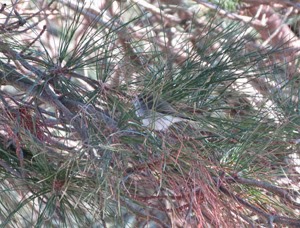
One of the rare pleasures of this investigative work is to stumble across the unexpected and we have had two such encounters in the past three days. Here is the first, a riroriro, or grey warbler seen on the track going down to the dune lake.
Spot the riroriro - white undercarriage centre-right
This is the NZ rainbird, whose song reportedly falls away in tone, ending abruptly, if the weather is about to take a turn for the worst. I remember trekking through Whanganui National Park territory as a greenhorn and querying the sagacity of this with a leathery old conservationist of around 75 years. She  looked me up and down as yet one more no-hoper who shouldn’t be allowed near a national park and walked away.

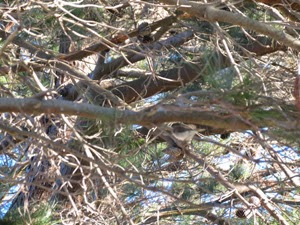
They are little bush birds, used to living in dense podocarp forest and a nightmare to photograph because they are difficult to focus and always on the move, fossicking out insects from the bark and foliage of trees. Rarely seen out in the suburbs like this,  nevertheless here they are -a pair- though we only managed a couple of messy images of one before they zipped away, across the wharemauku.   
Riroriro (in camouflage) - near dune lake
The nests of these tiny animals, that vie with rifleman for the title of NZ's smallest bird, (being little bigger than your thumb), are parasitized by the two native cuckoo’s, -the Shining and Long Tailed. These birds overwinter on South Pacific islands then migrate back to breed here in the spring. They don’t however, do the  legwork themselves, the females laying their eggs in riroriro nests. We have seen a long tailed fledgling, (koekoea) just out of the nest on the Island (Kapiti), with two riroriro parents, desperately trying to keep ahead of its appetite.

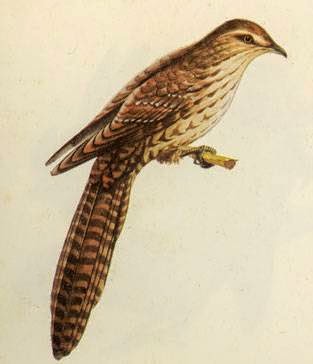
Long-tailed cuckoo - koekoea -ill. Keulemans
The long tailed, is the rarest of the NZ cuckoos and it has a loud gnarly cry, which it uses, like its human counterpart, to galvanise its parents into feeding it. This underlines the seeming tyranny of the situation for the fledgling, which throws the riroriro’s own eggs out of the nest, grows to 3 or 4 times the size of the parents. Though the parents could care less. It is their youngster and there is no way it is going to be left to starve.

The process raises intriguing (and intractable) questions about the influence of parenting on a fledgling. When Don Merton was down on Little Mangere Island. in the Chathams trying  to save the  black robins which were down to a last fertile female -Old Blue- (He was famously successful), the initial strategy was to cuckold the nests of tomtits, with black robin eggs. This gave Old Blue the opportunity to lay a further  clutch.  It had to be abandoned when the robins began to show tomtit-like behaviours. These cuckoos however, repeat the behaviour of the parents they have never seen, then the females in addition repeat their mother’s parasitic behaviours without however, ever being trained in the strategy themselves…

And our second surprise? The discovery of marine animals in our small wetland pond over the back of the wharemauku. There seems no obvious way fish can get in here, becasue it has been dry  between March and early April, and yet here they are!! It is also decidedly fetid with cattle having direct access to it. And if this wasn't enough, the expressway has it directly in its sights and is closing in fast from the north. More on all that next week.

Track we were listening to while posting this
The Big O's Blue Bayou  
I'm going back someday come what may to Blue Bayou
Where you sleep all day and the catfish play on Blue Bayou

Sunday, 29 June 2014

Ducklings 4


Welcome to the Midnight Collective Broadsheet 28
Actively supporting NZ’s endangered wetland birds
Parera/Mallard with 4 chicks June 24
Back here in Kapiti we were a little surprised to find our mallard/parera mother, was still in residence in the wetland. Her original brood had been reduced to four yet they were obviously putting on weight and looked a feisty bunch. Sadly however, none had survived by the weekend.

3 orphans
The pukeko had returned, and taken up residence around the duck and her offspring, and though she still seemed more than a match for them, within two days, she had abandoned her charges, leaving three orphans on the island, none of whom, survived the night.

We’ll never  know exactly what happened, though the finger of suspicion initially pointed up two possible suspects -the pukeko were number one, until a domestic black cat was seen loitering beside the island the day of their disappearance. The cat is a regular, but seldom ventures out this far into what has now become a fetid marsh, so it may have been on the look out for the ducklings.

But rats also live around the water, and then we have seen stoats not so far away, beside the nearby Andrews Pond.

However, in what seemed a giveaway two kahu (harrier hawks) came swinging by the island, over the lake on Friday morning. It remains supposition, but they circled the pond area a number of times, and then one came back for a second look, about 20 minutes later. They generally don’t come in this low to the blackberry which may indicate they’ve found food here recently. Then again, in our experience it is very rare for a mother to leave her chicks. We’ve seen it only once before, when a female left a sole surviving youngster, after being pestered by a persistent male. She obviously had mixed emotions because she kept returning to the duckling before finally leaving. Yet even this adolescent didn’t survive the night without her.
Kahu over dune lake
So was the mother forced to save herself, when discovered by predators who could have made a meal of both her, and her young?

We have better news from the  kotare who continues to haunt the area of wasteland at the back of the airport. We presume  it's the male from the yellow tinge on the lower breast and because this is  his perch – though if it is, then he’s lost a lot of colour since the last time we saw him. And no sign of the female for a while now. Though given the kotare's predatory reputation, (this one looks  pretty well fed for the depths of winter), he would be well up to taking a stray duckling or two!!  

Track we were listening to while posting this
Dave Van Ronk –See That My Grave Is Kept Clean.
Stolen from the Master -Blind Lemon Jefferson- then used by Dylan on his first album – but this is better! Though what were two 21 year olds hoping to achieve by trying themselves out against the Mountain? It’s  like a graduate actor trying themselves out onKing Lear.

Well, my heart stopped beating and my hands turned cold
And, my heart stopped beating and my hands turned cold
Well, my heart stopped beating and my hands turned cold
Now I believe what the bible told  

Sunday, 22 June 2014

Top of the Lake


Welcome to the Midnight Collective Broadsheet 27
Actively supporting NZ’s endangered wetland birds

We have been away for a few days, staying at Te Moenga Bay, at the top end of Lake Taupo, in the middle of the North Island. It’s the shortest day and there’s good snow on the mountain (Ruapehu) though not yet ski-able because  the middle of winter falls nearer mid-July.
The Mountain - volcanic Ruapehu wearing his winter coat 
At this time of the year every nz scaup in this region seems to make a beeline for Te Moenga, and the little bay on the opposite side of the lake. It is difficult to get an accurate count, because they are a diving duck and not always visible above surface, but we reckoned up 75 to 80 here, with another 50 on the other shore.
 
NZ Scaup on Taupo 
We haven’t seen scaup in Kapiti for at least two months, and though we don’t know where ours migrate to in winter, it would be surprising if they travelled this far, because they aren’t seasoned flyers. The only seem to fly at night and gain lift off with a furious whirr of their wings before hurtling along close to the surface. They may also be nocturnal, at least to some degree, because like this lot above, they spend  a lot of time sleeping on top of the water.

They appear to collect like this for social reasons. There were obvious mating rituals taking place (bolshy confrontational behaviour by the males was a sure sign). But here at the top of the lake there is plenty of food for them. So perhaps it is a winter feeding ground as well. Adding some grist to this theory are the many shags, who come in on sunny winter afternoons to dry themselves and roost on the local launches. Here pied and black shags perch happily together, while the occasional little shag can be spotted hoovering up the inanga (and their cousins), close in to the shore.
 
Fishing launch with shags and scaup Lake Taupo 
Where is she?
The big surprise however, was the appearance of a pair of dabchicks, the first we have spotted at the lake. They too were feeding and perhaps had been together some time; though this didn’t stop the male going into something of a panic when the female strayed too far away.

They have a ritual ‘smooch’ fluttering about together while burying their noses underwater after drifting part while feeding, though this seems to be initiated by the  male who kept a constant watch on her movements. These little endemic grebes can spend 12-15 seconds under water, and then dive again immediately. He became quite agitated at her insouciance though she, for her part seemed nonplussed, and a little impatient with the fuss.
Dabchick pair at rear, male on left
Track we were listening to while posting this
Sharon King and the Dapkings ‘I learned the hard way.
I learned the hard way
That your love is cruel
I learned the hard way, baby
Not to be your fool


Monday, 16 June 2014

Ducklings 3


Welcome to the Midnight Collective Broadsheet 26
Actively supporting NZ’s endangered wetland birds

We now have a ‘situation’ down at the dune lake with our winter’s nest of duckling chicks having survived their first week out in the open in very arduous conditions. For this, the credit is all down to the experience and canny instincts of their mother, who has been under virtual siege the entire time with the pukeko’s moving back into her terrain. Yet the lake is also providing her with much better camouflage at this time of the year. 
2 oblivious pukeko with frozen watchful female duck -chicks underneath
Pukeko’s are usually vegetarian but will take any young chicks they can, and put some thought into their raiding parties. We’ve seen them taking ducklings, pied stilt youngsters and even black swan cygnets, though to give them their due the adults divvy up the proceeds between their own chicks. (We have also seen a very hungry kahu-harrier hawk trying to lift a fully grown pukeko out of the swamp. It didn't have much of a show as the pukeko went beserk, but still, they too, can come under attack.)

They can co-ordinate their attacks, raiding a nest from the front and rear simultaneously, and an inexperienced or dithering parent makes an easy target. This is why it is so useful to have a pair of paradise ducks around during the breeding season, because they are vigilant and fierce and keep the pukekos at a wary distance.

This is not this mother’s first brood because she obviously has experience with pukeko. She is ever on the watch for them and freezes her brood under her whenever they are around – which is most of the time. And yet contrary to our previous assertion, that we didn’t think there was a great deal of food around yet, for the ducks, they do seem to be finding plenty of sustenance in the growing lake.

We have tried to be cautious in publicising the locality of this dune lake. Even experienced local conservationists are not aware of it,  and the wisdom of this was brought home when three youngsters intercepted us while we were filming. 

The next thing the boys were over the fence and into the lake in their gumboots to try and get a closer look. They meant no harm to the animals, but scattered them in a panic nevertheless. Yet it was instructive watching the birds reaction to this intrusion. The pukekos immediately lit out for the WBY (wild blue yonder) which relieved the pressure on the mother duck, who remained motionless until the boys passed inside her comfort zone. She then took her charges into the water, waiting again to see if the danger would pass and when it didn’t, disappeared into the blackberry.      
Female duck with brood
Keeping tabs on these wild lives, in the centre of a town like this, can be a harrowing business. You never know from one visit to the next, how these birds have fared and every trip is marked with a growing sense of trepidation over their fate, especially as we monitor this seasonal nesting aberration.

Nevertheless – so far so good.

Track we were listening to while posting this 
Lennon and McCartney -Your Mother Should Know 
Lift up your hearts and sing me a song
That was a hit before your mother was born
Though she was born a long long time ago
Your mother should know